

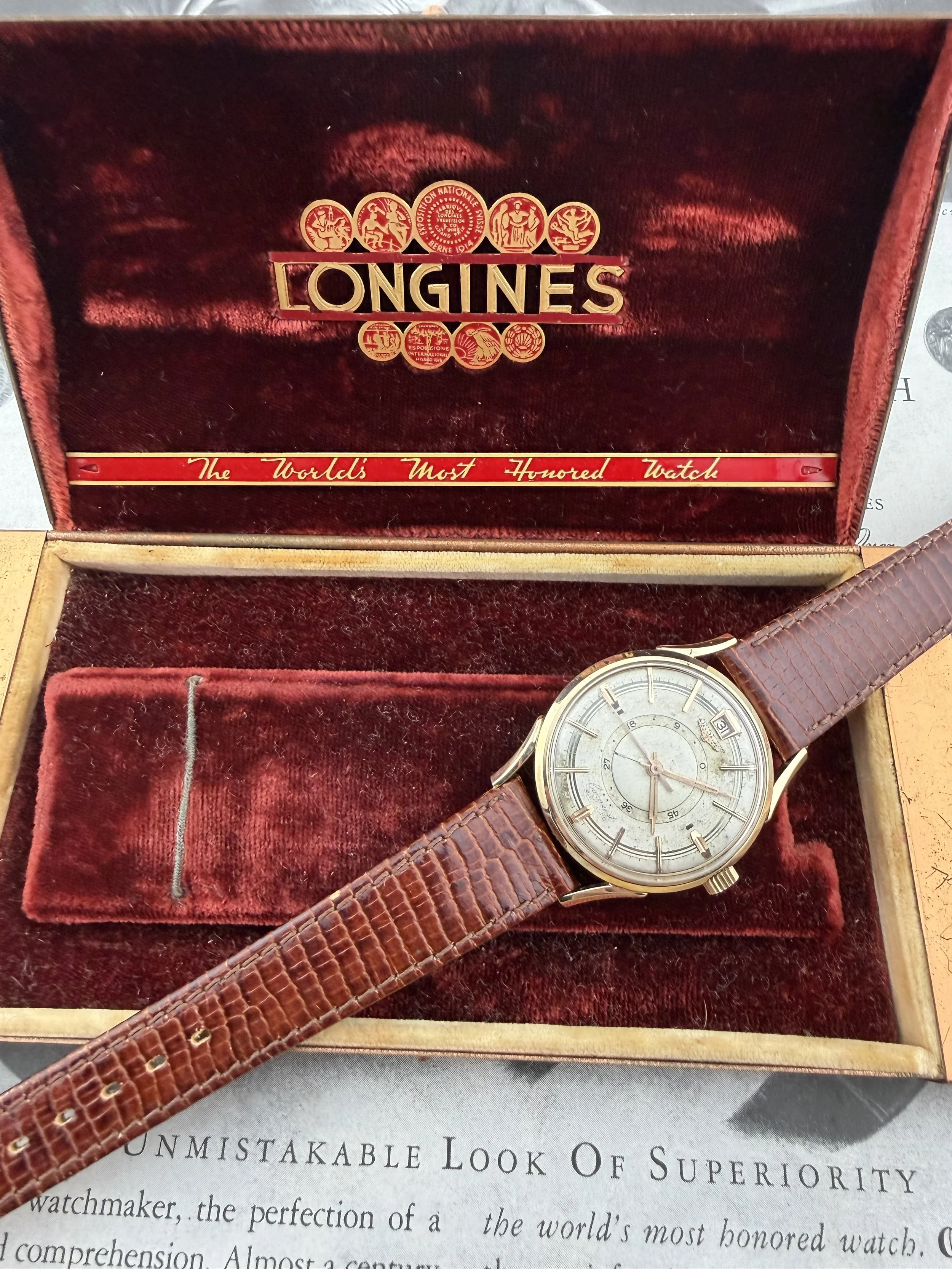
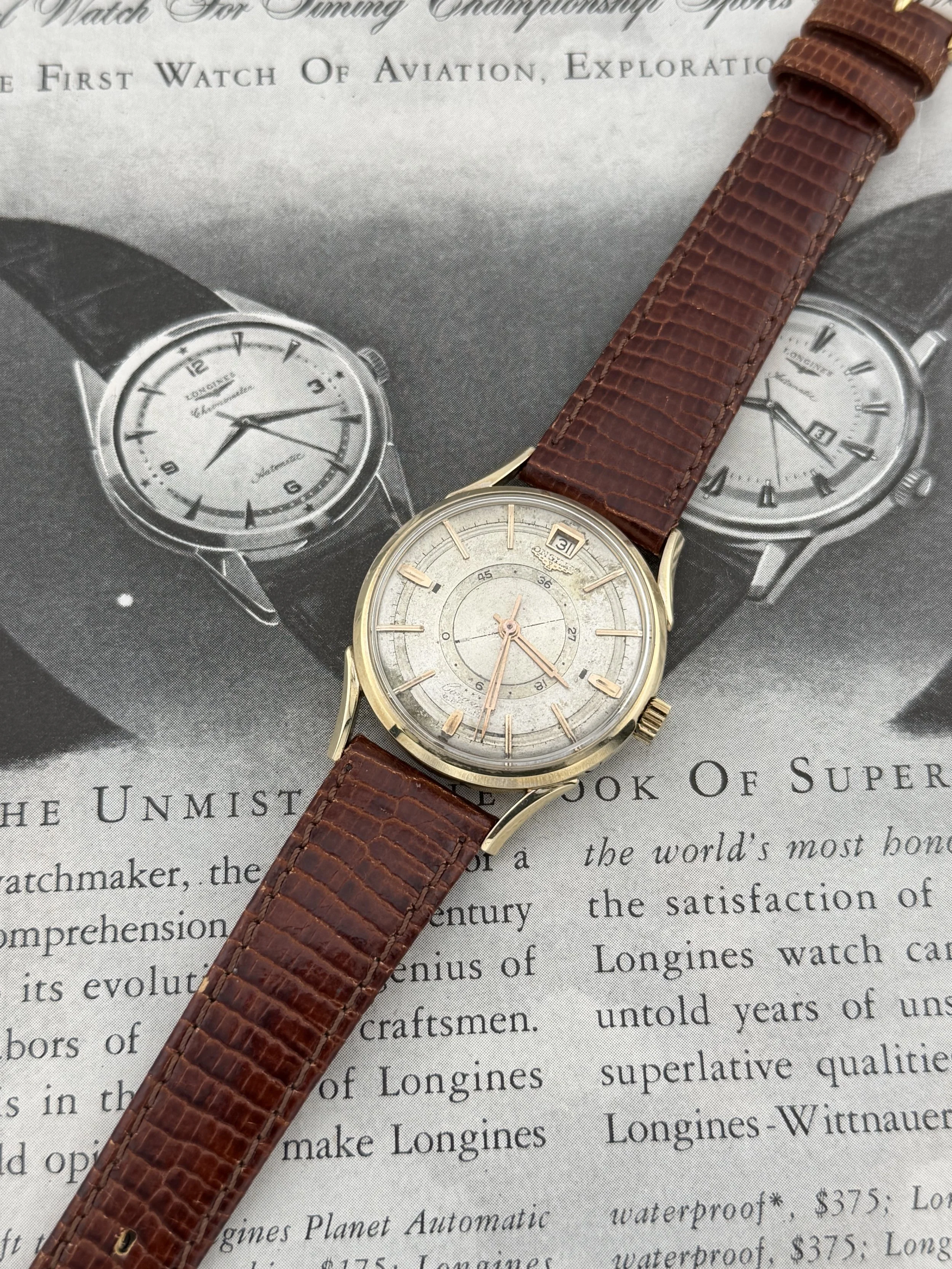
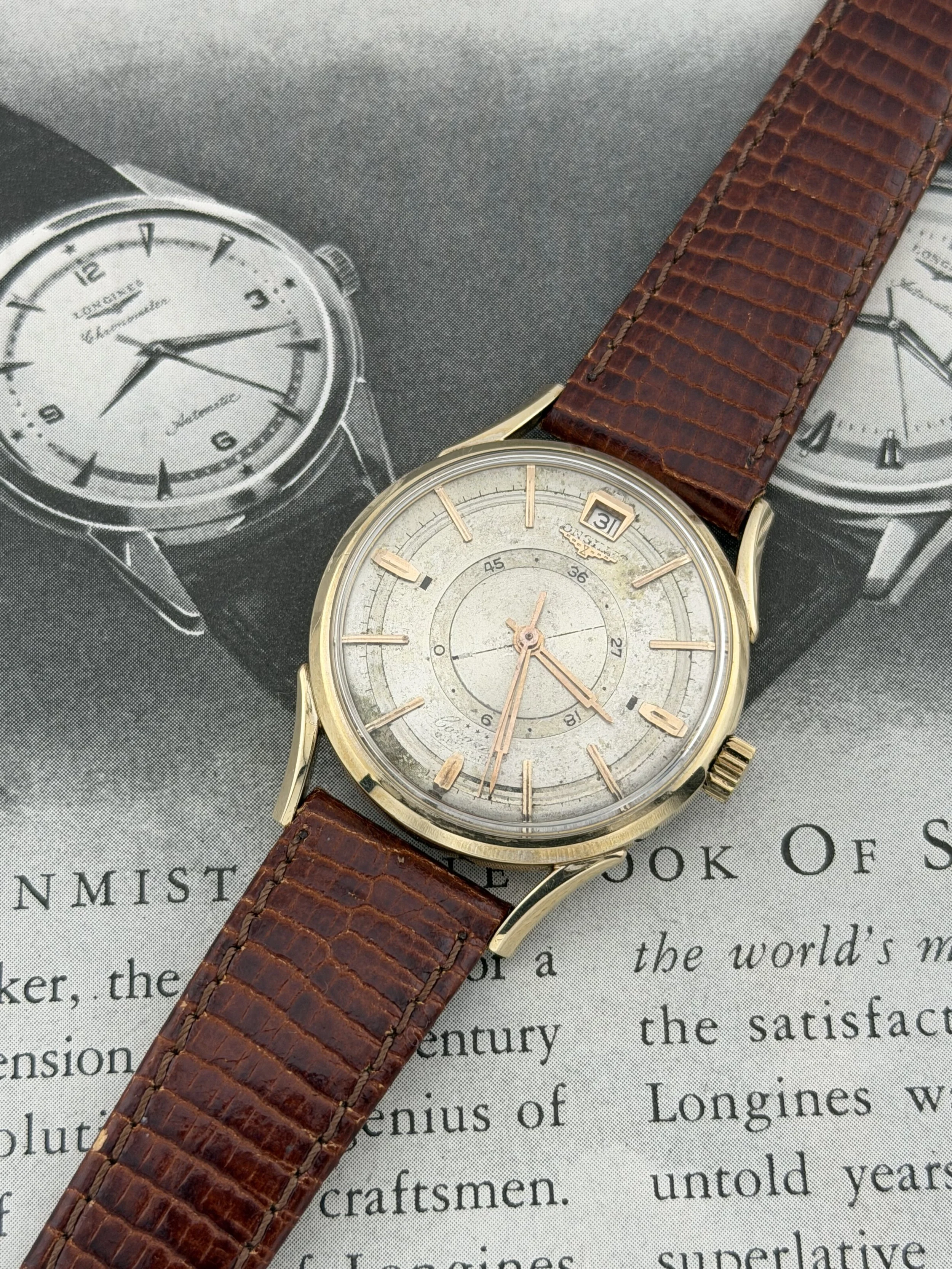
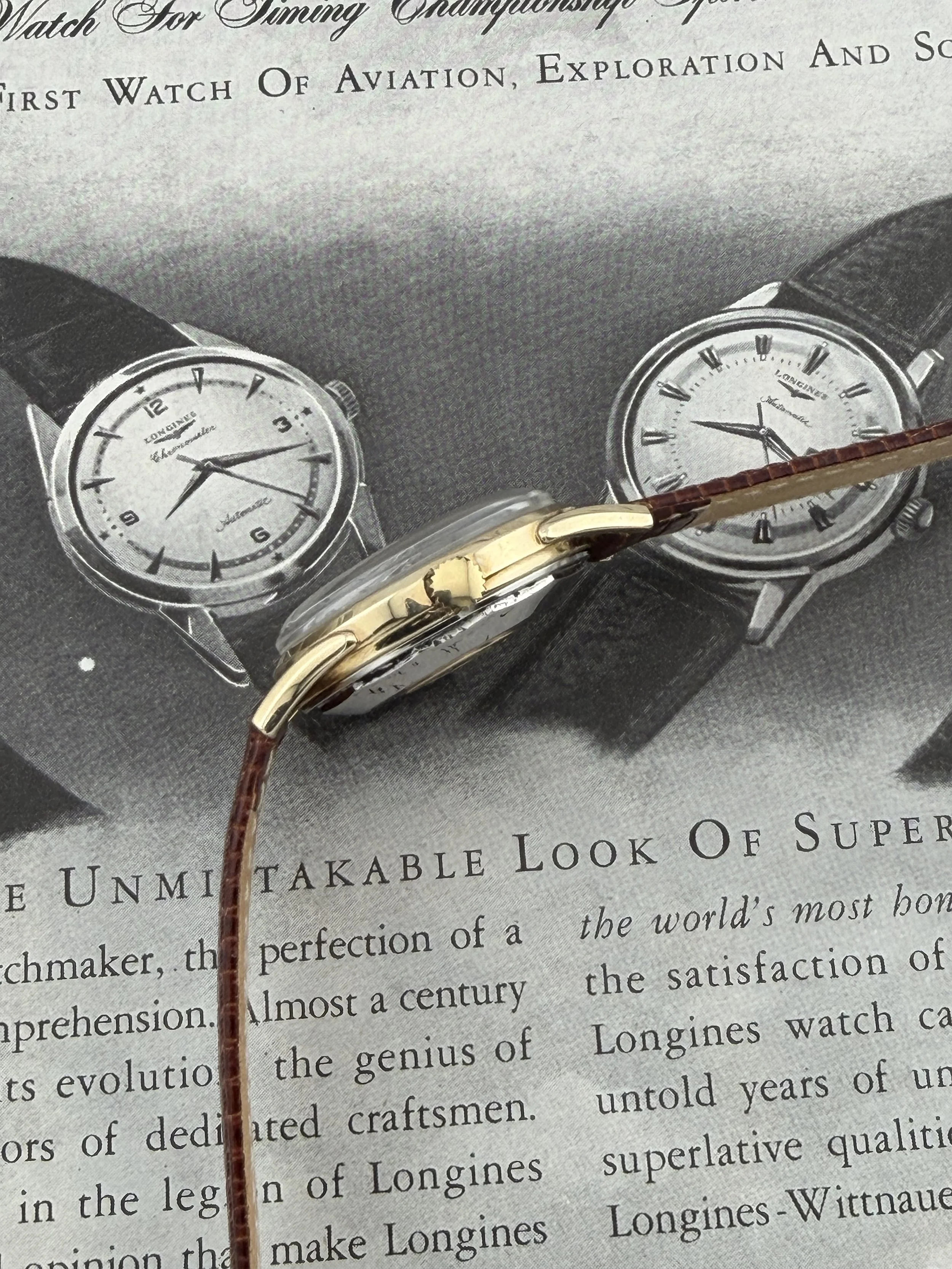
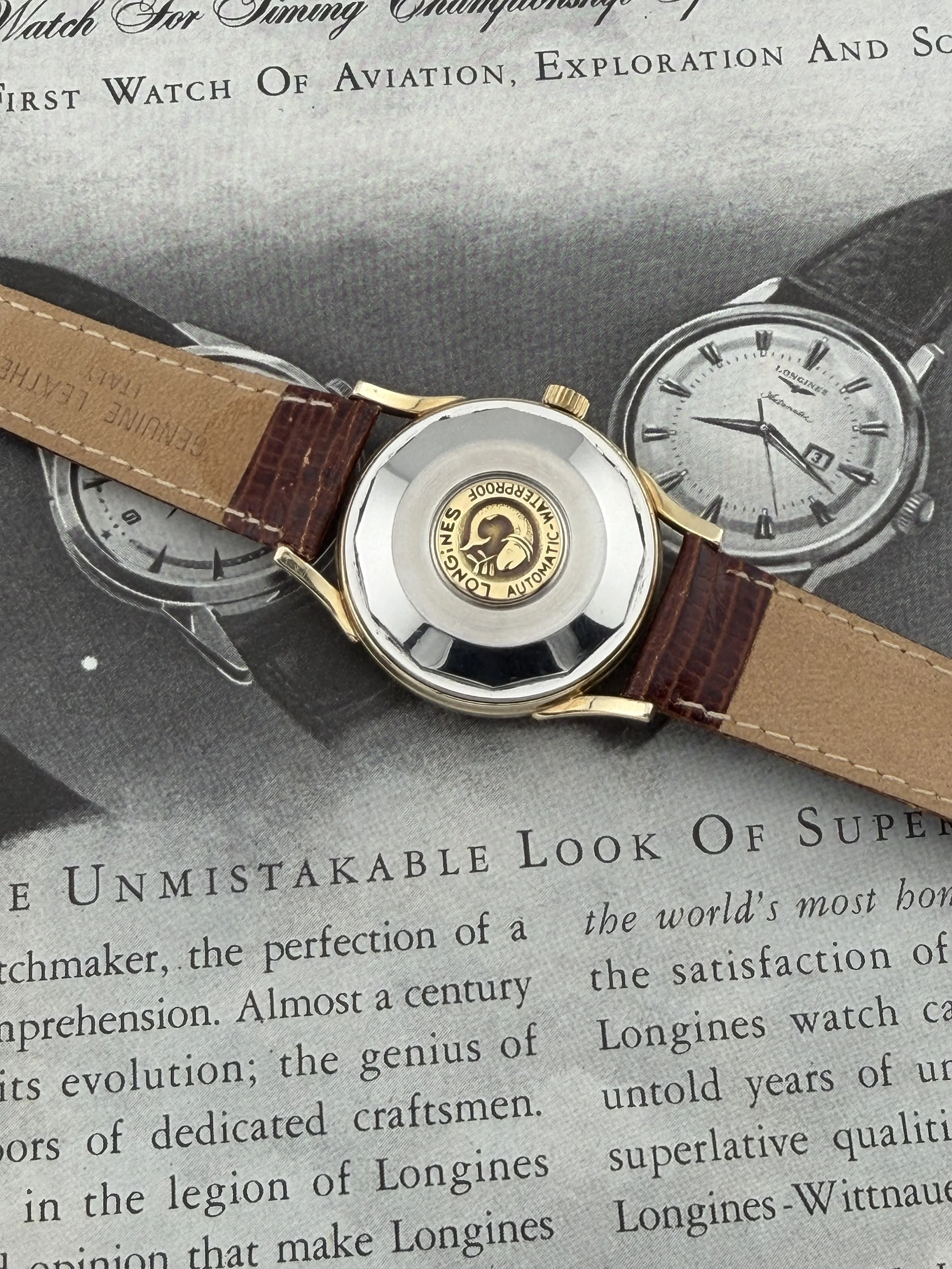
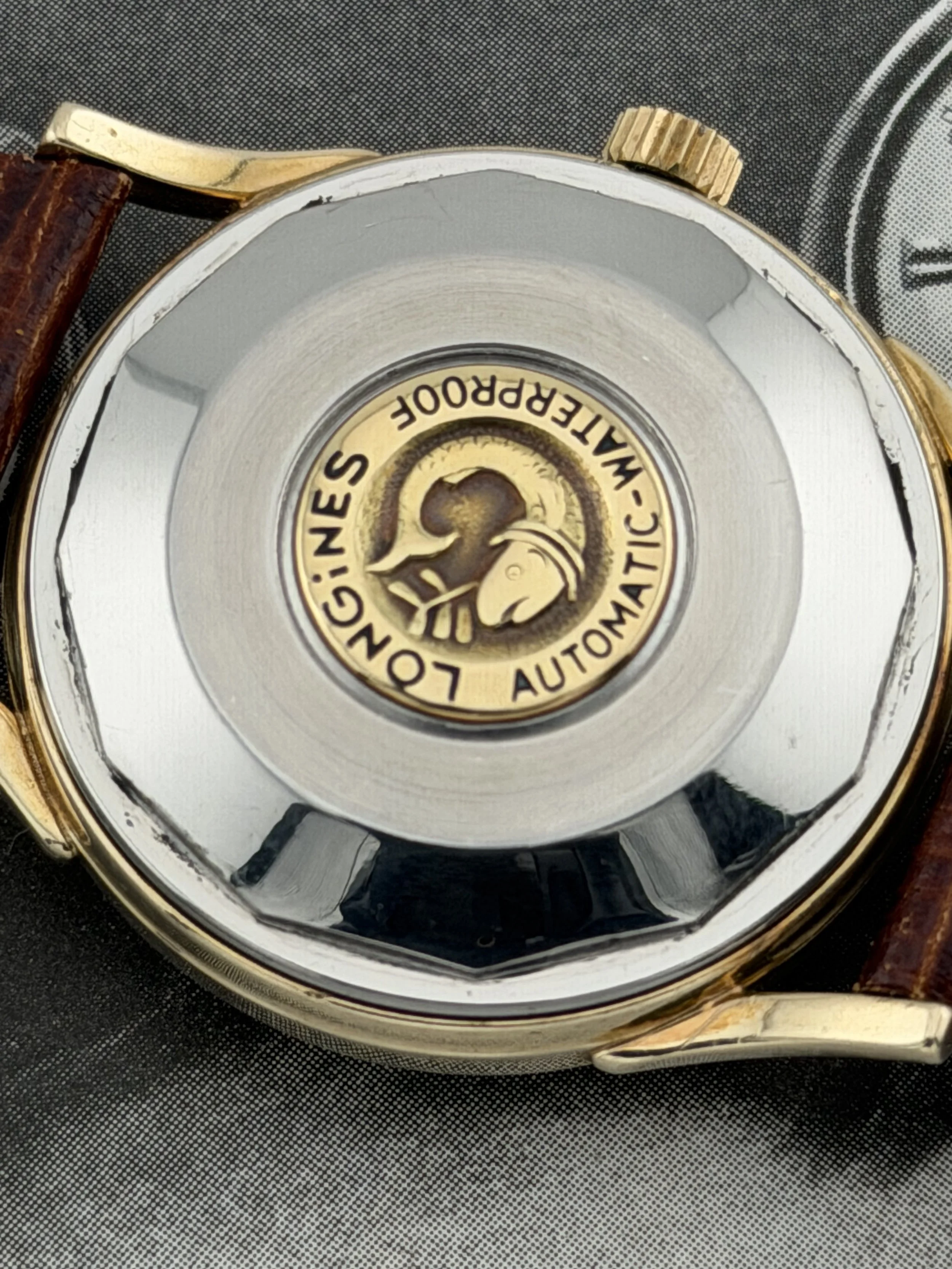
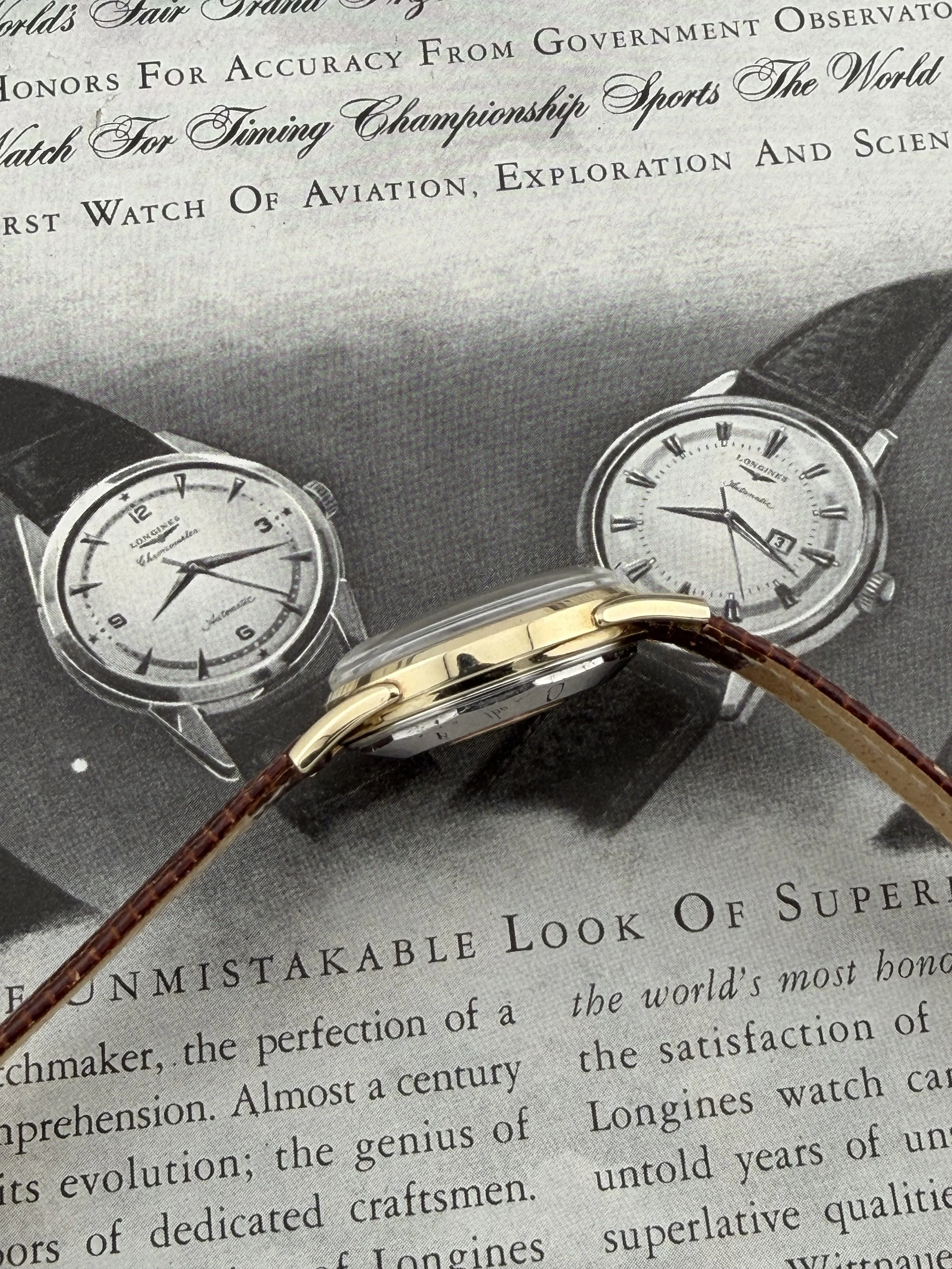
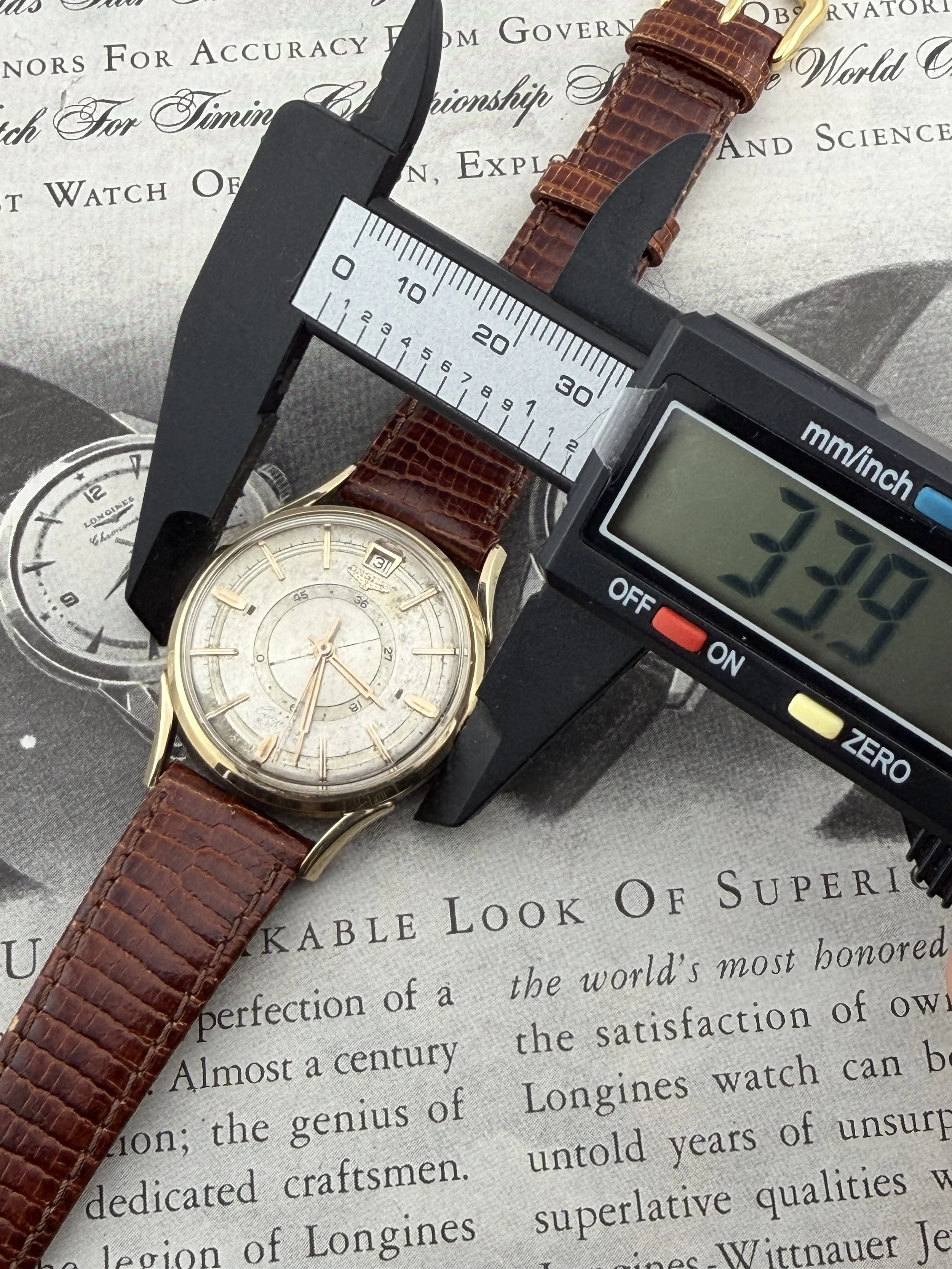
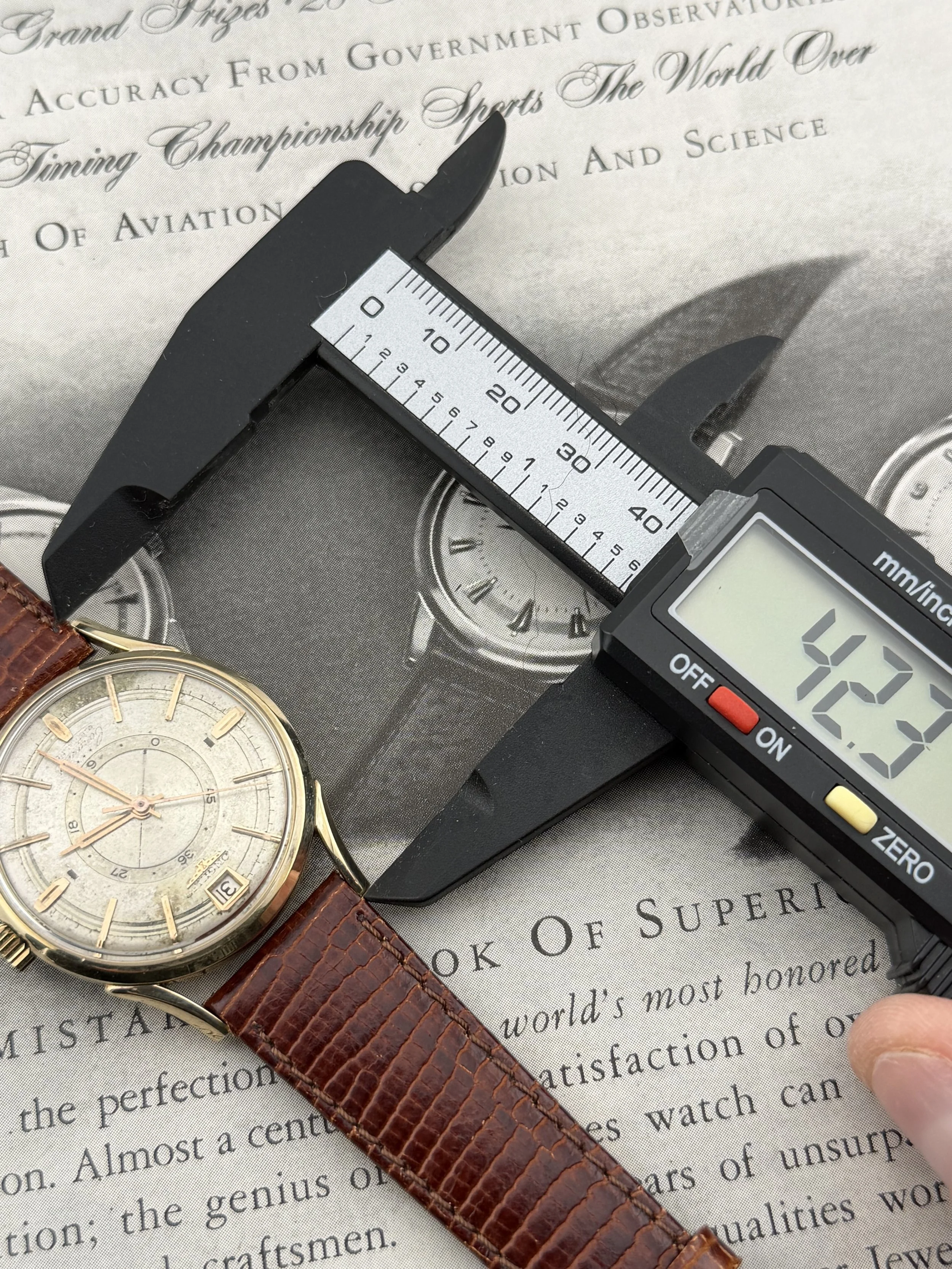
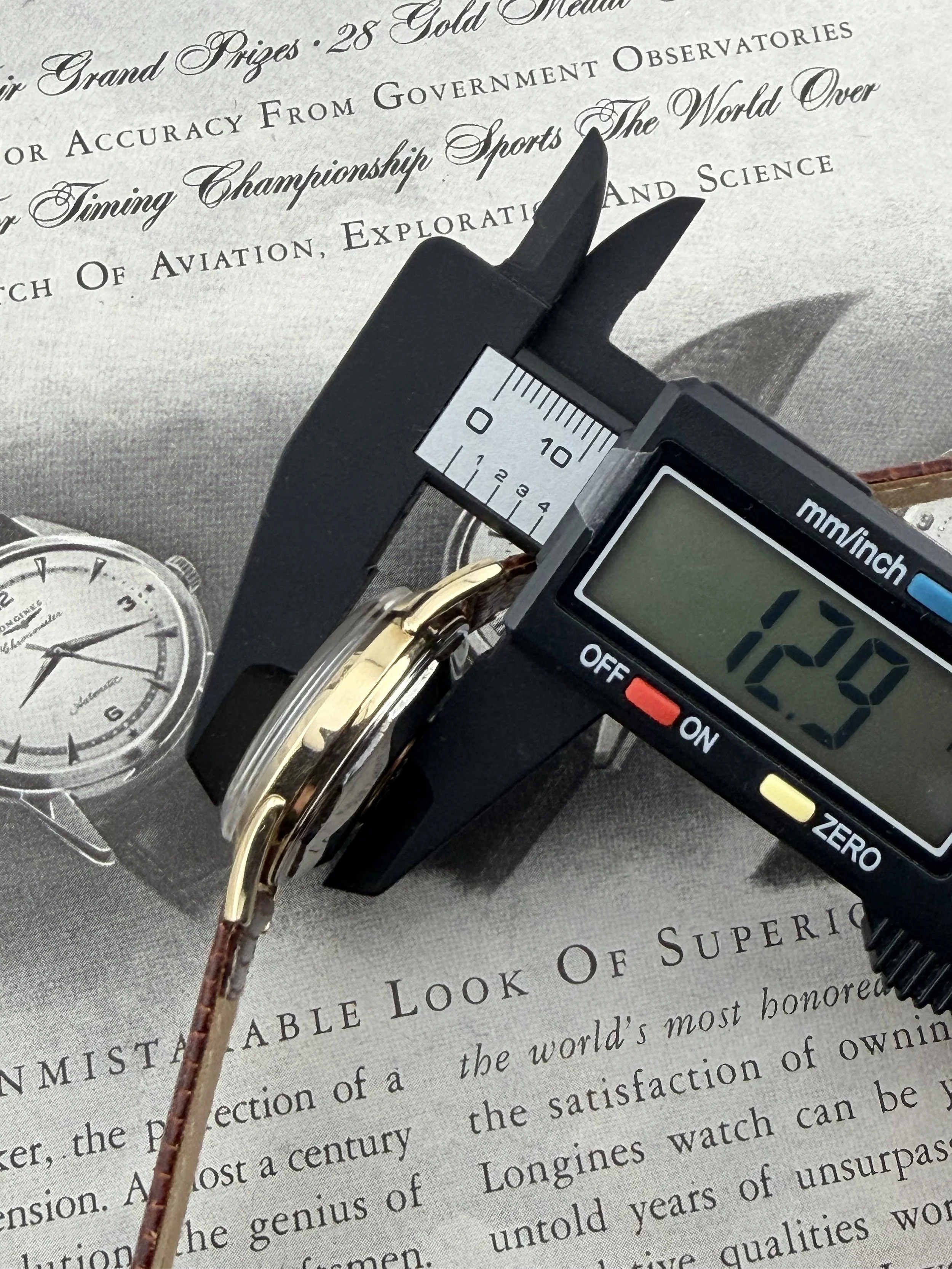
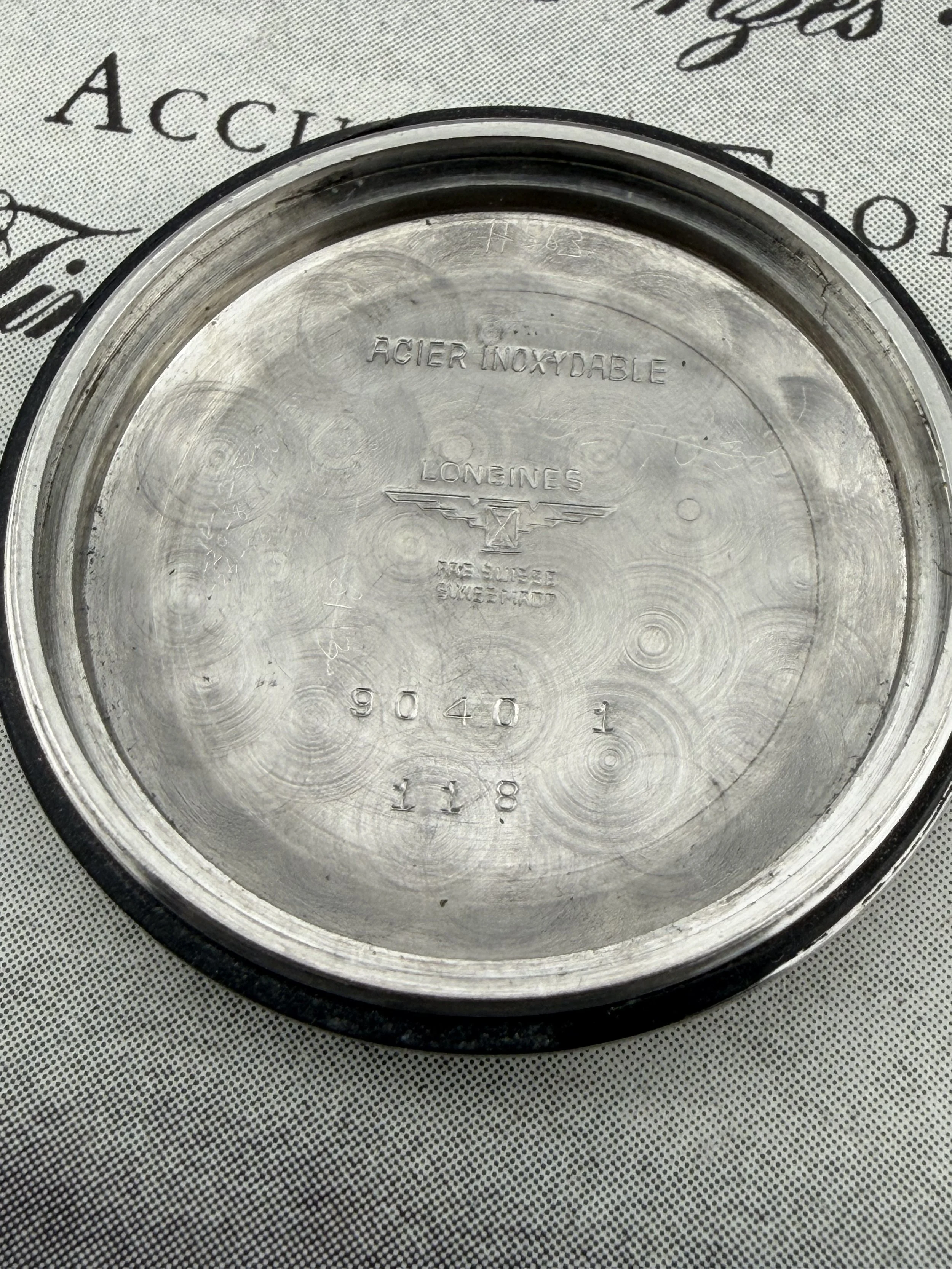
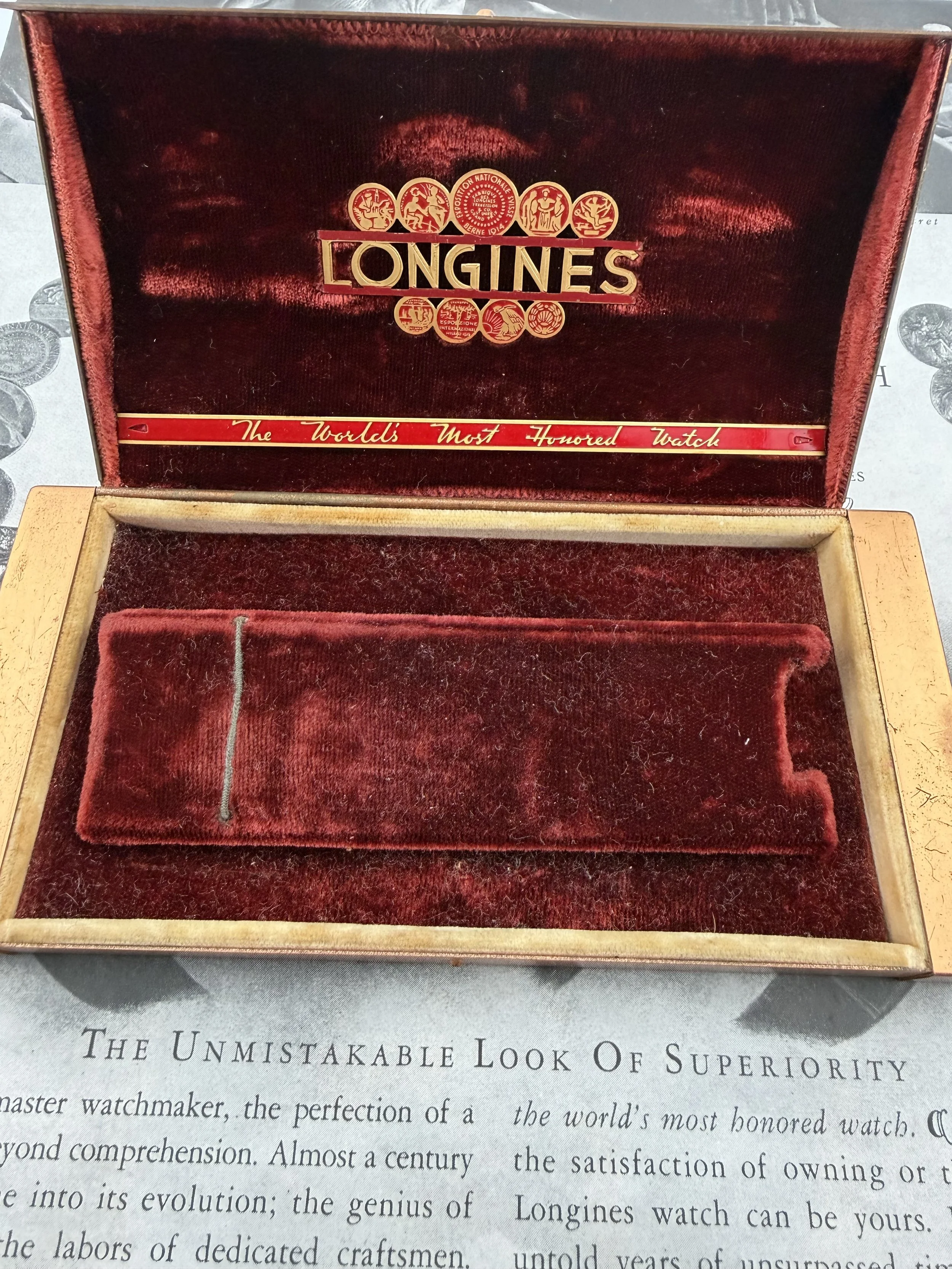
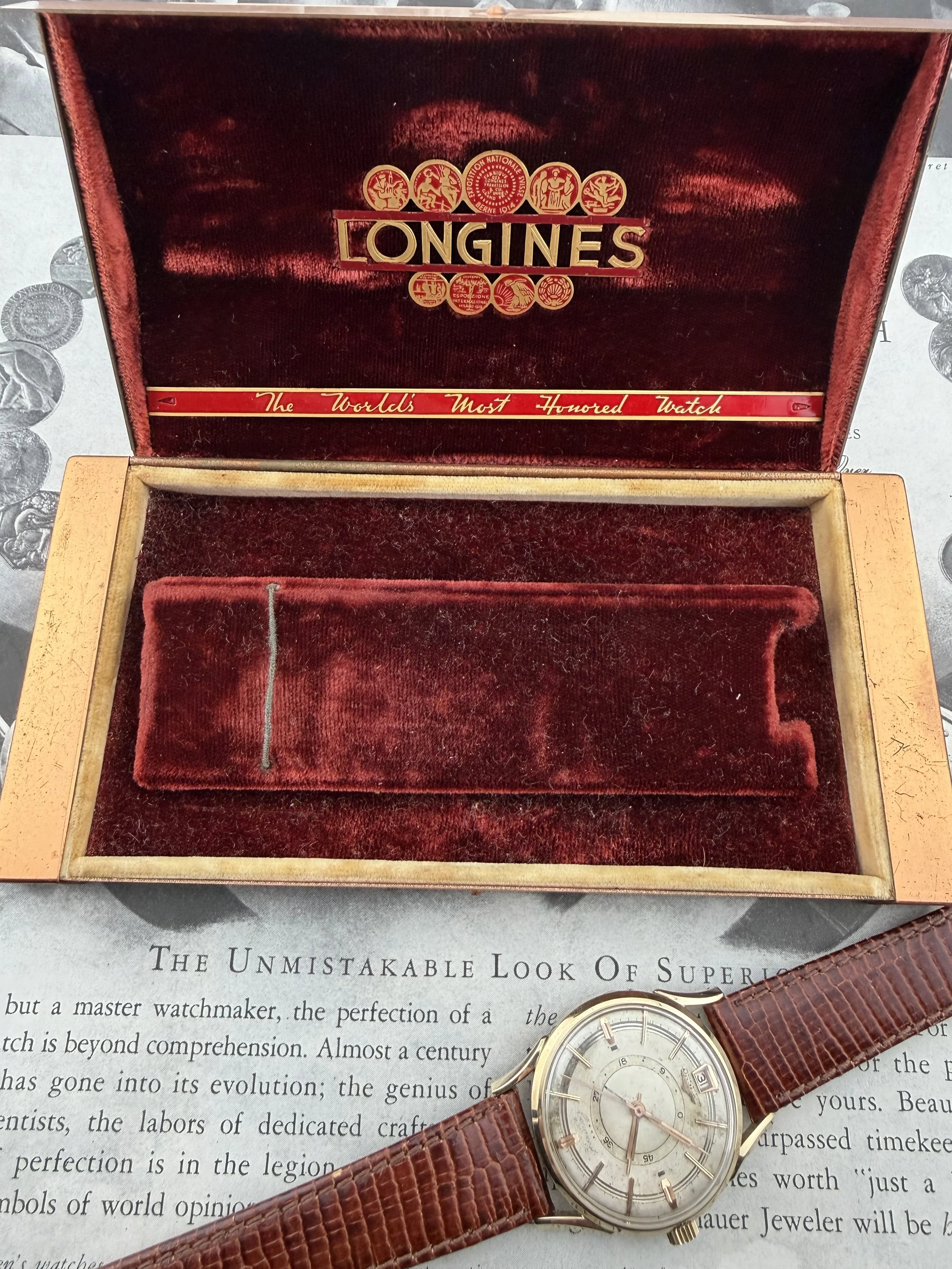
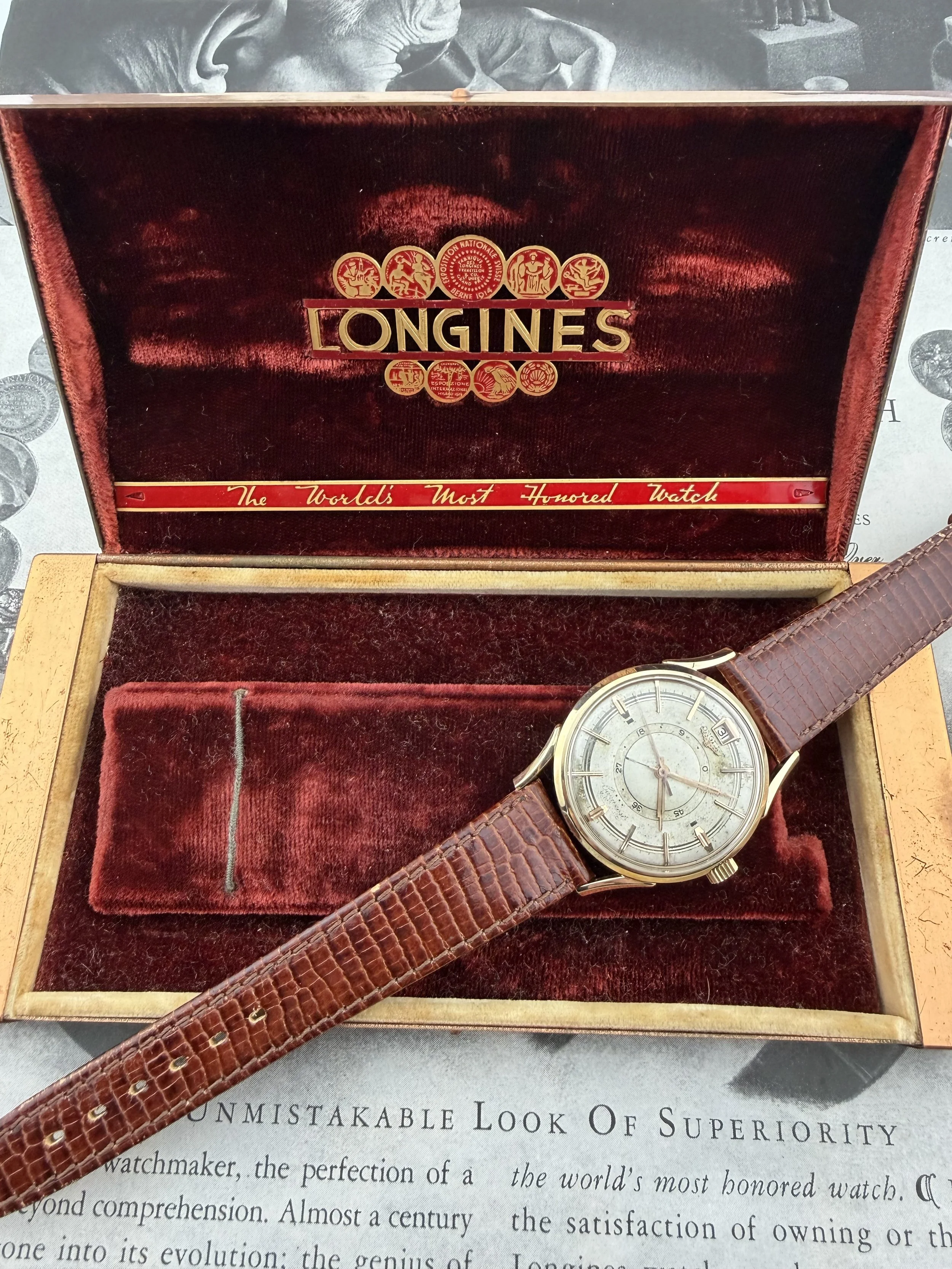
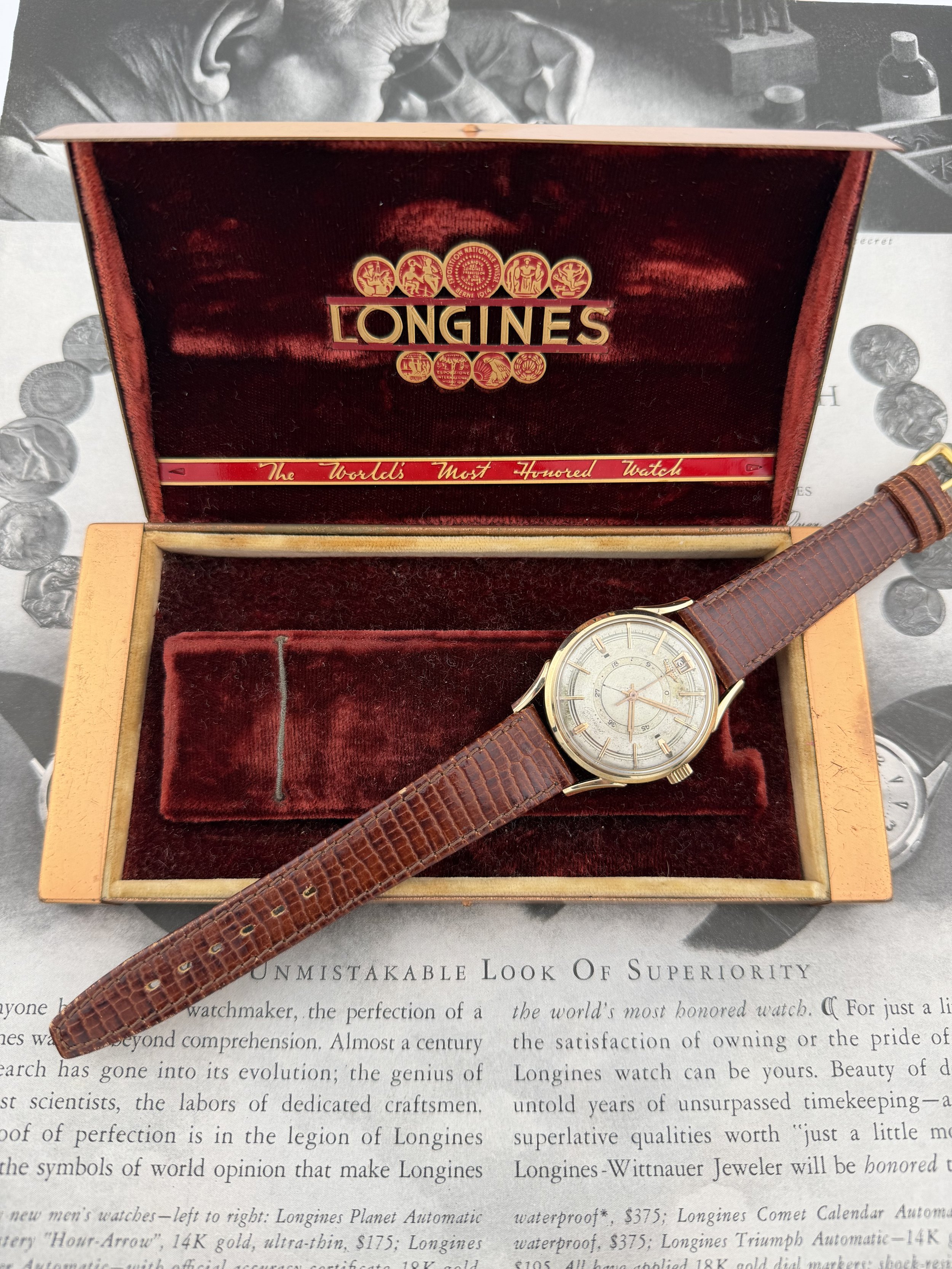
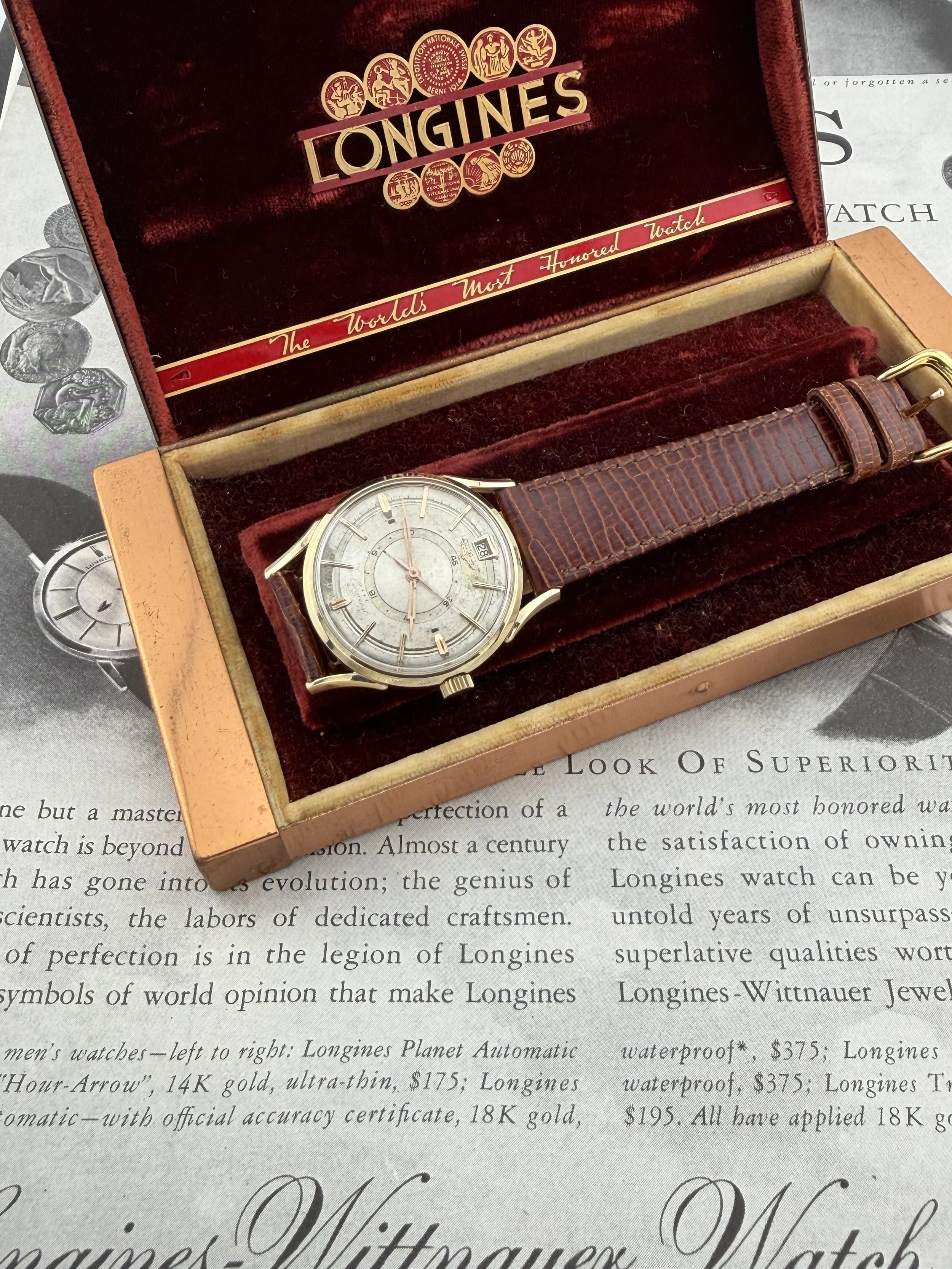
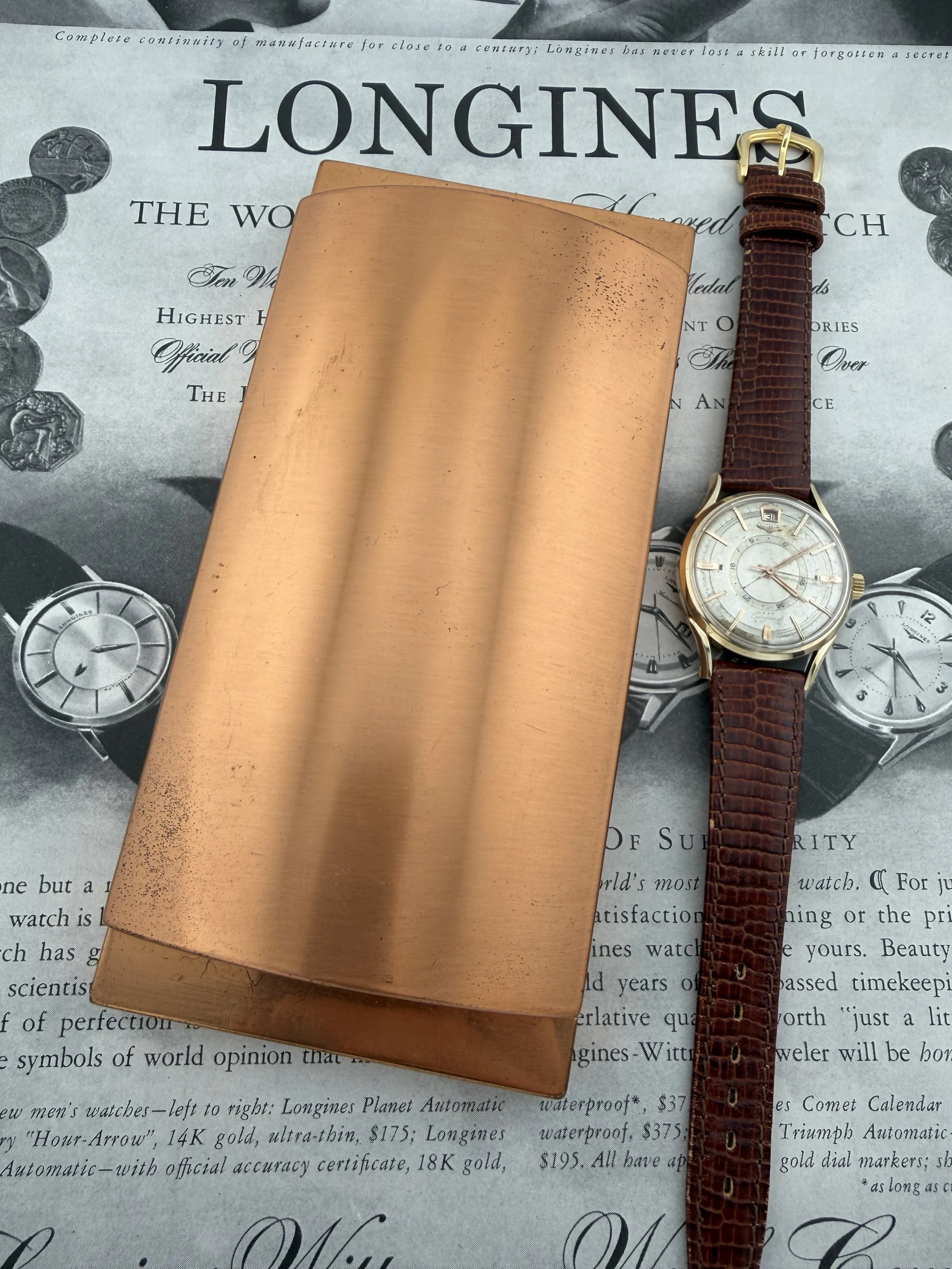
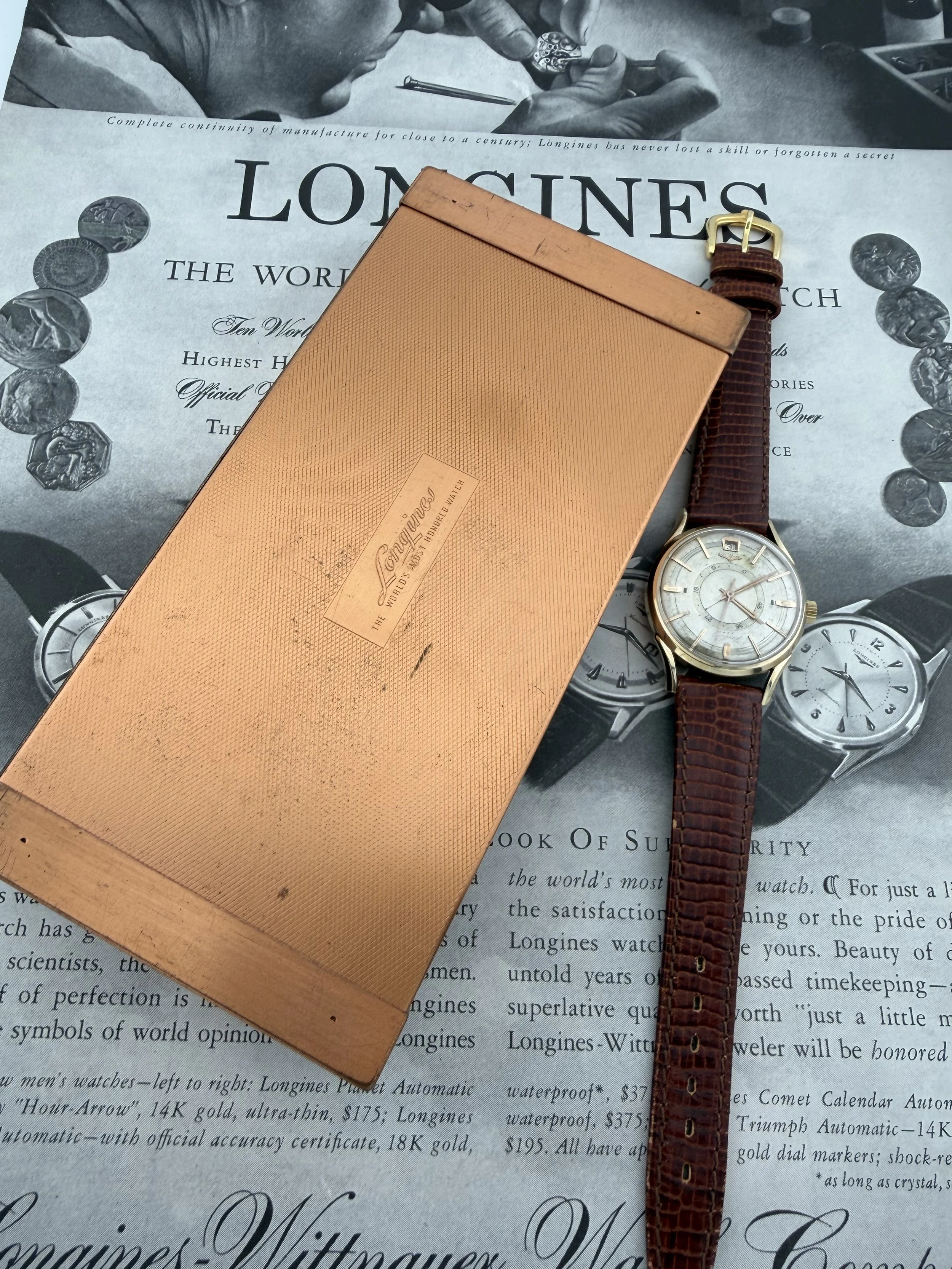
This highly collectible Longines Conquest is a remarkable example of Swiss watchmaking from the late 1950s, combining the sporty character of the Conquest collection with one of the period’s more unusual mechanical complications. The approximately 33.9mm gold-capped case features a stainless steel screw-down case back, complete with the iconic Conquest fish-and-kelp emblem.
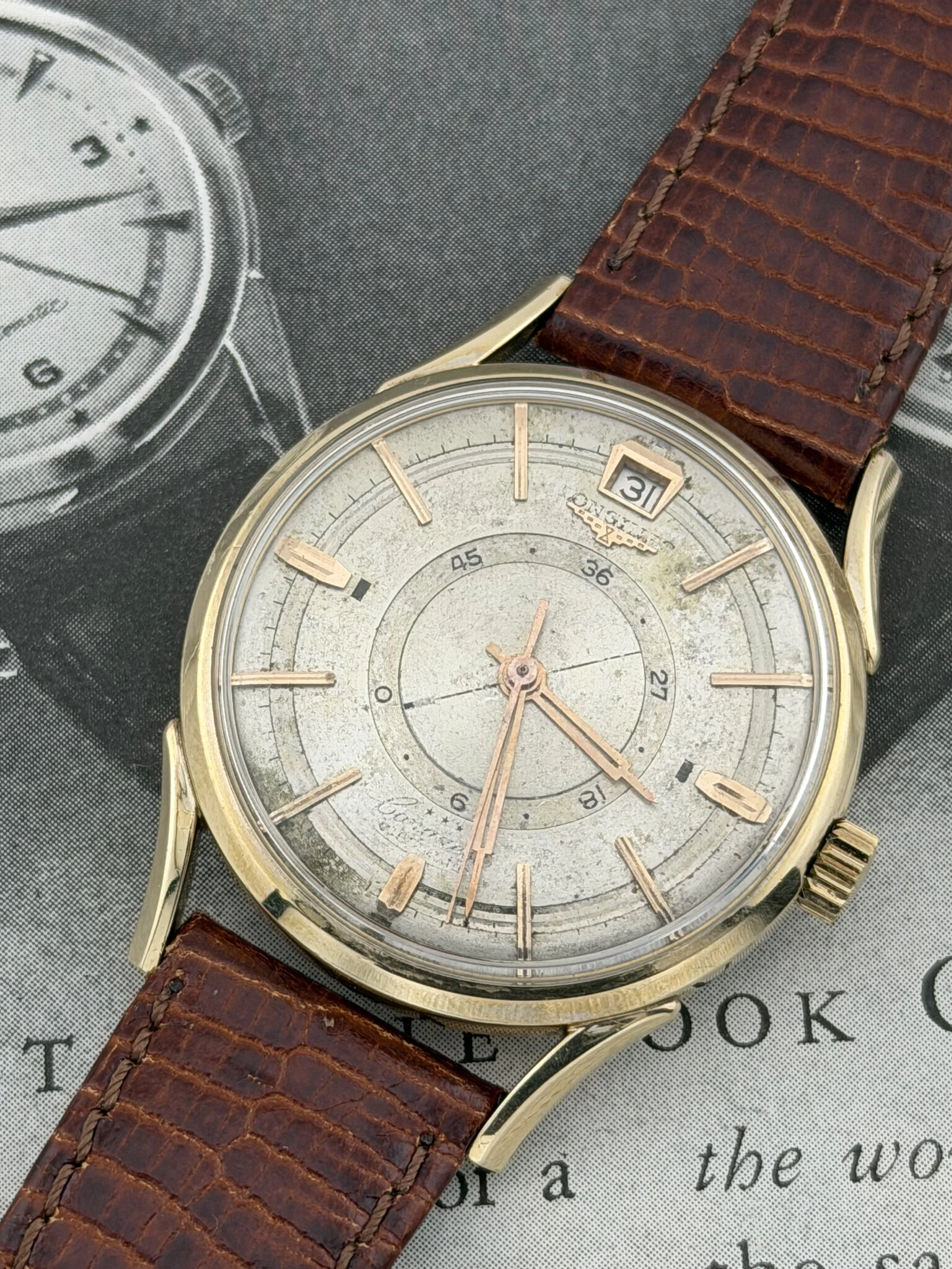
The naturally aged dial is particularly striking, with faceted gold-tone indices and elegant dauphine-style hands surrounding the unusual central power-reserve display. Rather than using a conventional hand or sub-dial, the power reserve is shown through rotating discs at the centre of the dial. As the mainspring winds down, the discs change position to indicate the remaining energy available to the movement, with approximately 45 hours of running time represented.
This was an ingenious solution to a very practical problem. A power-reserve indication allows the wearer to know how much longer an automatic or mechanical watch can continue running before it needs to be wound or worn again. Longines took the concept a step further by integrating the indication directly into the centre of the dial, creating a complication that is both technically interesting and visually distinctive.
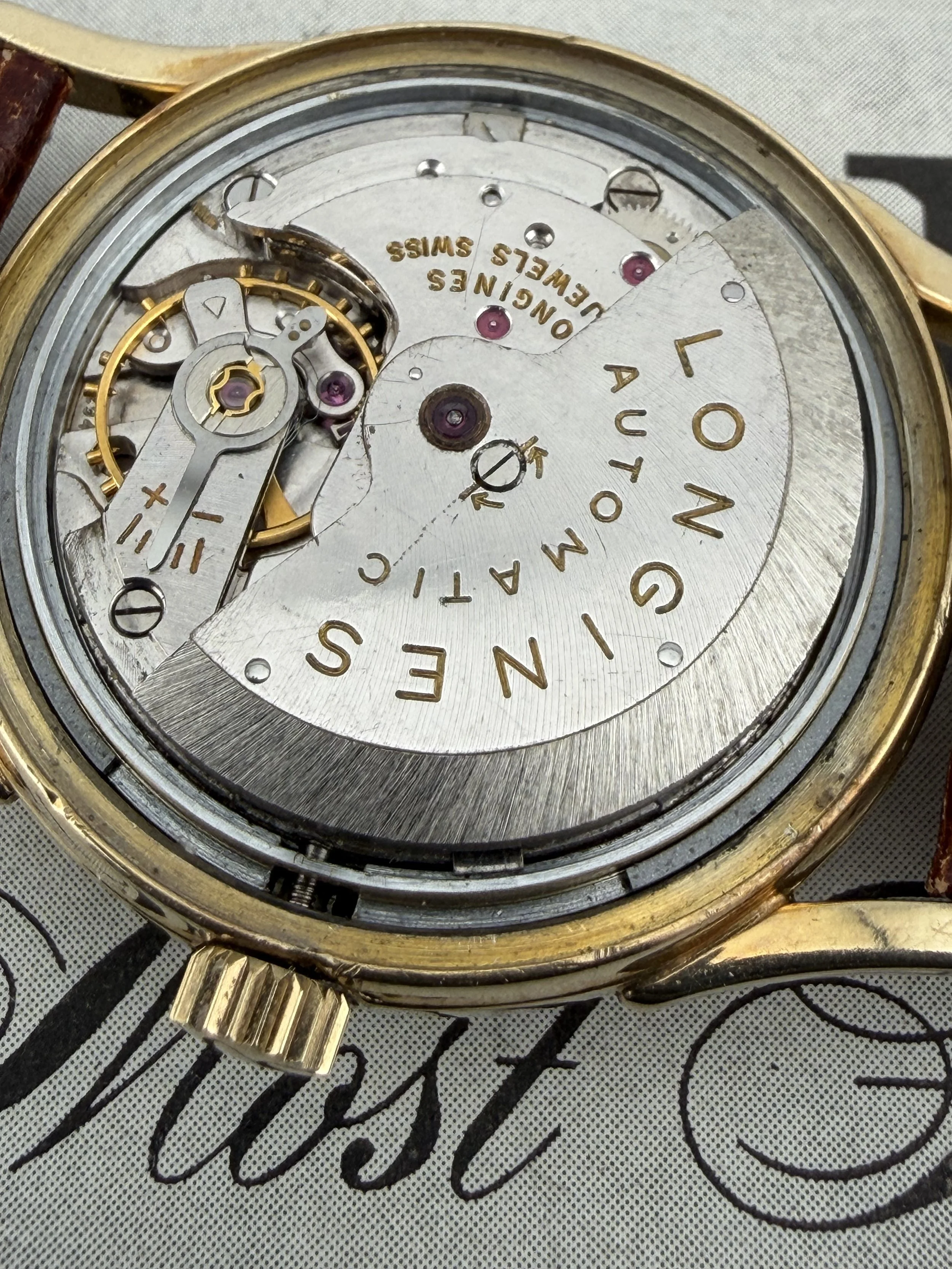
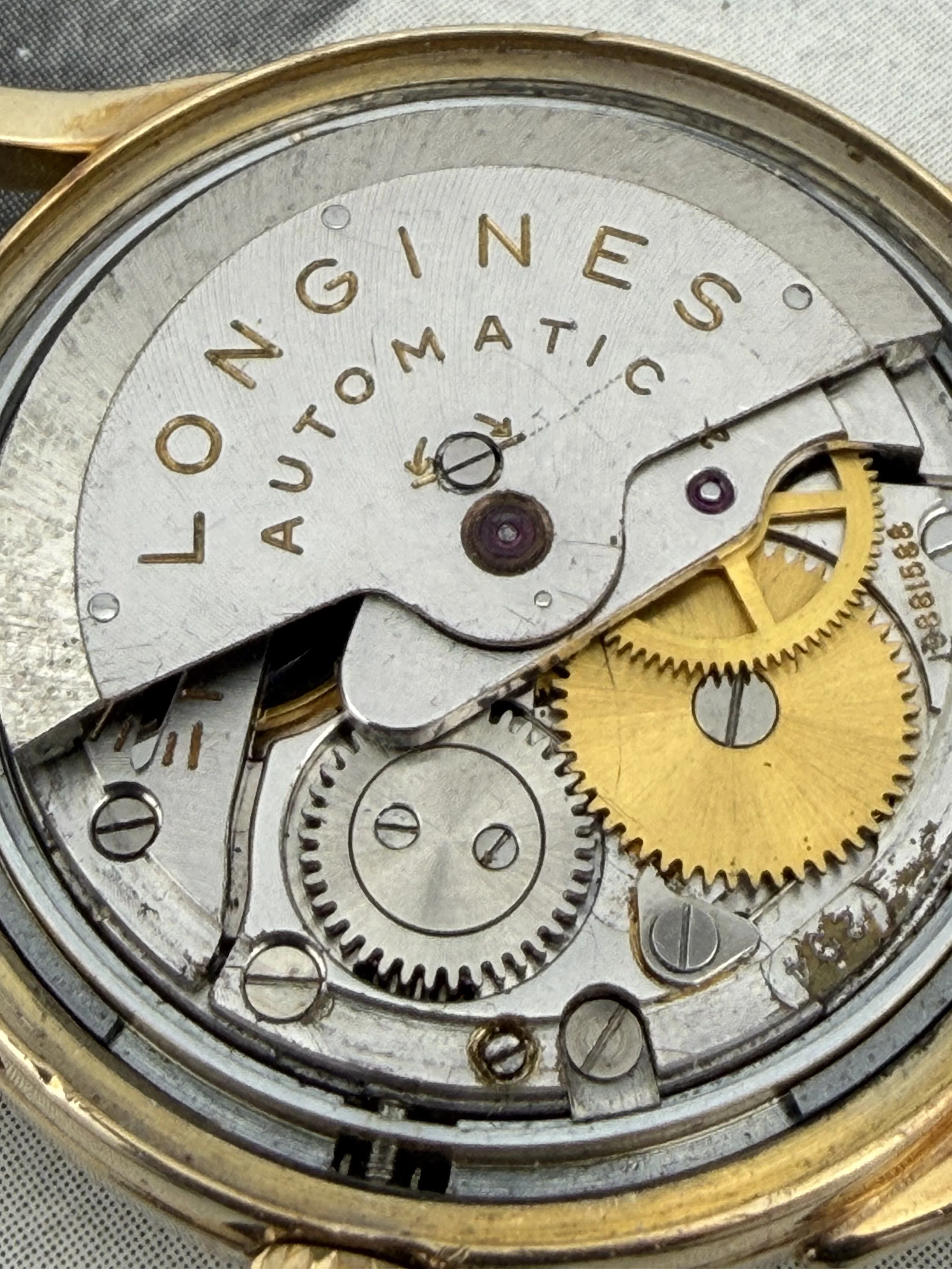
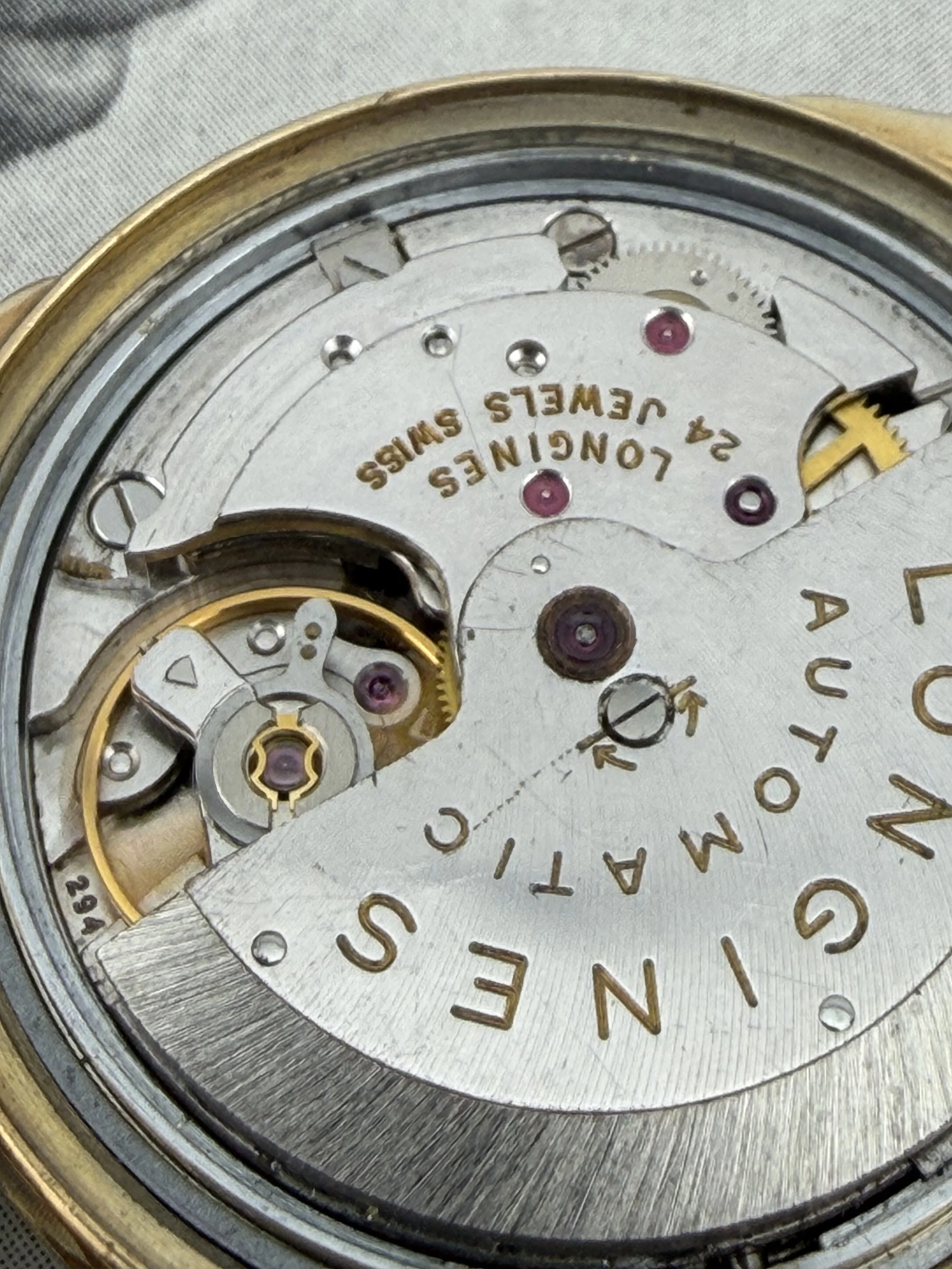
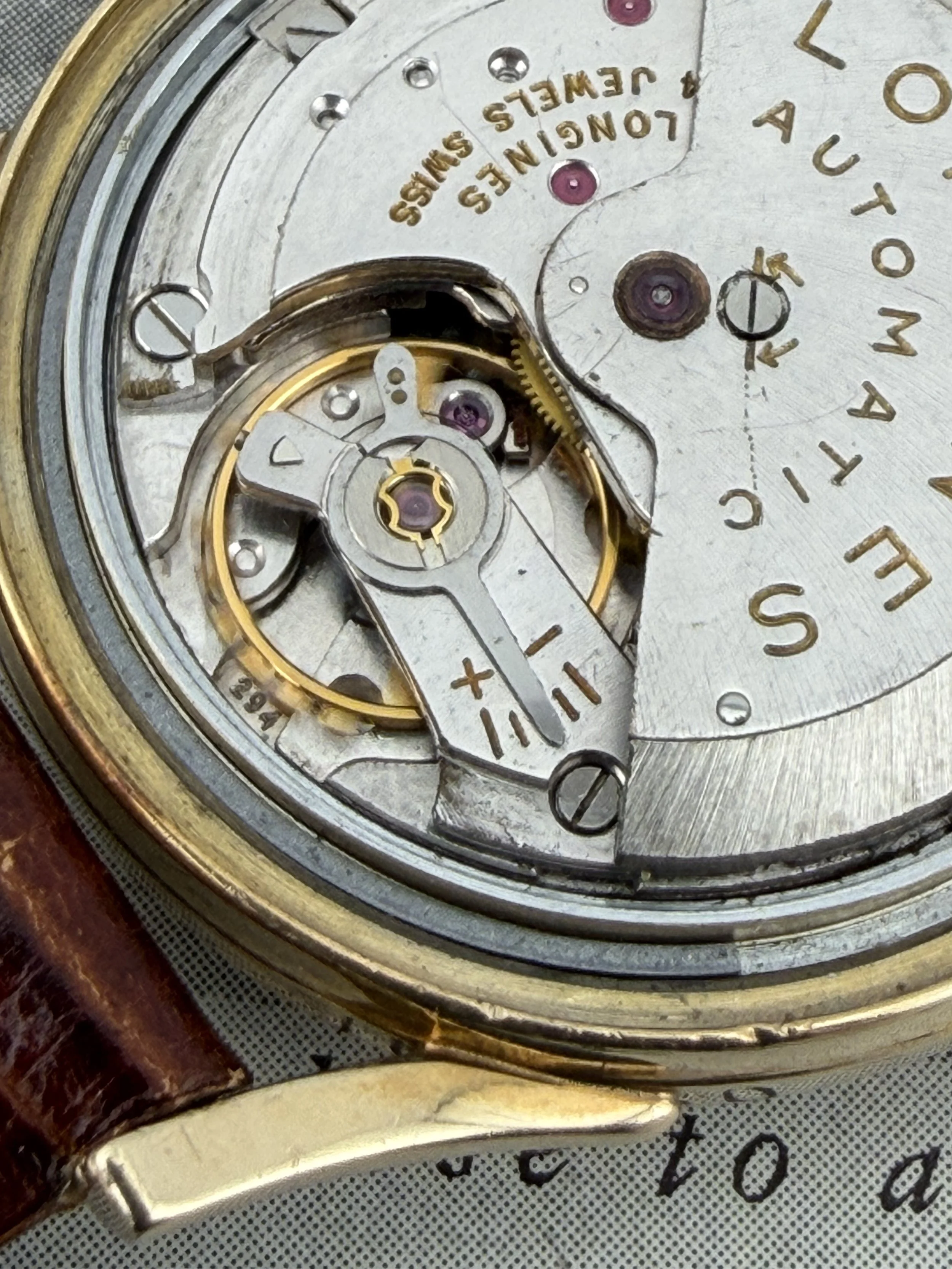
Inside is the Longines Caliber 294, a 24-jewel automatic movement with a date display at 12 o’clock and the central power-reserve mechanism. The movement serial number 10881588 places this watch around 1958–1959, making it an excellent representation of Longines during an important period of mechanical innovation.
Longines itself has an extraordinary history. The company traces its origins to 1832 in Saint-Imier, Switzerland, where Auguste Agassiz established a watchmaking business. In 1867, his nephew Ernest Francillon established the Longines factory at a location known as Les Longines, giving the company its enduring name and introducing the famous winged-hourglass trademark. Longines went on to become an important name in precision timekeeping, aviation, exploration, and sport, developing a reputation for technical innovation alongside its emphasis on elegance.
The significance of this particular watch has only grown with time. In 2024, Longines revived this unusual complication as the Conquest Heritage Central Power Reserve, introduced to celebrate the 70th anniversary of the Conquest collection. The modern watch deliberately takes inspiration from the late-1950s original, retaining the distinctive idea of displaying the power reserve on rotating discs in the centre of the dial.
The modern interpretation measures 38mm and uses Longines' automatic Caliber L896.5, offering a substantially longer 72-hour power reserve, but the basic visual concept remains remarkably faithful to the pioneering vintage design. The fact that Longines chose this specific complication to revive more than six decades later speaks to the originality and lasting importance of the original watch.
That connection makes this vintage Conquest particularly fascinating. It isn't simply an early Longines with an unusual dial—it represents a design and mechanical idea that was distinctive enough for the company to bring back for a new generation more than 60 years later.
With its gold-capped case, beautifully aged dial, 24-jewel automatic movement, date display, iconic Conquest case back, and exceptionally unusual central power-reserve complication, this is a genuine piece of Longines history. A remarkable late-1950s Conquest that connects directly to one of Longines' most interesting modern heritage reissues.
This highly collectible Longines Conquest is a remarkable example of Swiss watchmaking from the late 1950s, combining the sporty character of the Conquest collection with one of the period’s more unusual mechanical complications. The approximately 33.9mm gold-capped case features a stainless steel screw-down case back, complete with the iconic Conquest fish-and-kelp emblem.
The naturally aged dial is particularly striking, with faceted gold-tone indices and elegant dauphine-style hands surrounding the unusual central power-reserve display. Rather than using a conventional hand or sub-dial, the power reserve is shown through rotating discs at the centre of the dial. As the mainspring winds down, the discs change position to indicate the remaining energy available to the movement, with approximately 45 hours of running time represented.
This was an ingenious solution to a very practical problem. A power-reserve indication allows the wearer to know how much longer an automatic or mechanical watch can continue running before it needs to be wound or worn again. Longines took the concept a step further by integrating the indication directly into the centre of the dial, creating a complication that is both technically interesting and visually distinctive.
Inside is the Longines Caliber 294, a 24-jewel automatic movement with a date display at 12 o’clock and the central power-reserve mechanism. The movement serial number 10881588 places this watch around 1958–1959, making it an excellent representation of Longines during an important period of mechanical innovation.
Longines itself has an extraordinary history. The company traces its origins to 1832 in Saint-Imier, Switzerland, where Auguste Agassiz established a watchmaking business. In 1867, his nephew Ernest Francillon established the Longines factory at a location known as Les Longines, giving the company its enduring name and introducing the famous winged-hourglass trademark. Longines went on to become an important name in precision timekeeping, aviation, exploration, and sport, developing a reputation for technical innovation alongside its emphasis on elegance.
The significance of this particular watch has only grown with time. In 2024, Longines revived this unusual complication as the Conquest Heritage Central Power Reserve, introduced to celebrate the 70th anniversary of the Conquest collection. The modern watch deliberately takes inspiration from the late-1950s original, retaining the distinctive idea of displaying the power reserve on rotating discs in the centre of the dial.
The modern interpretation measures 38mm and uses Longines' automatic Caliber L896.5, offering a substantially longer 72-hour power reserve, but the basic visual concept remains remarkably faithful to the pioneering vintage design. The fact that Longines chose this specific complication to revive more than six decades later speaks to the originality and lasting importance of the original watch.
That connection makes this vintage Conquest particularly fascinating. It isn't simply an early Longines with an unusual dial—it represents a design and mechanical idea that was distinctive enough for the company to bring back for a new generation more than 60 years later.
With its gold-capped case, beautifully aged dial, 24-jewel automatic movement, date display, iconic Conquest case back, and exceptionally unusual central power-reserve complication, this is a genuine piece of Longines history. A remarkable late-1950s Conquest that connects directly to one of Longines' most interesting modern heritage reissues.