

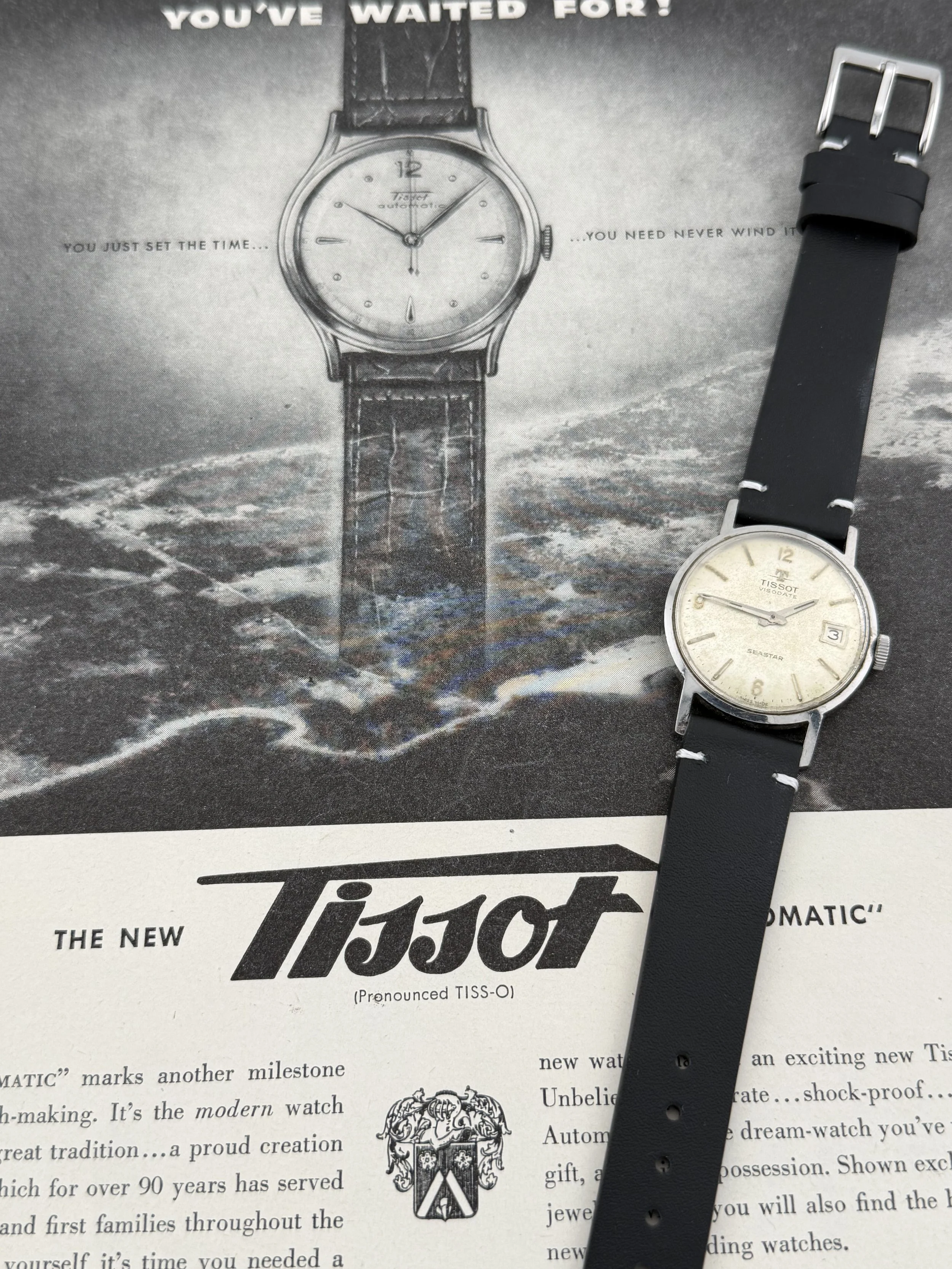
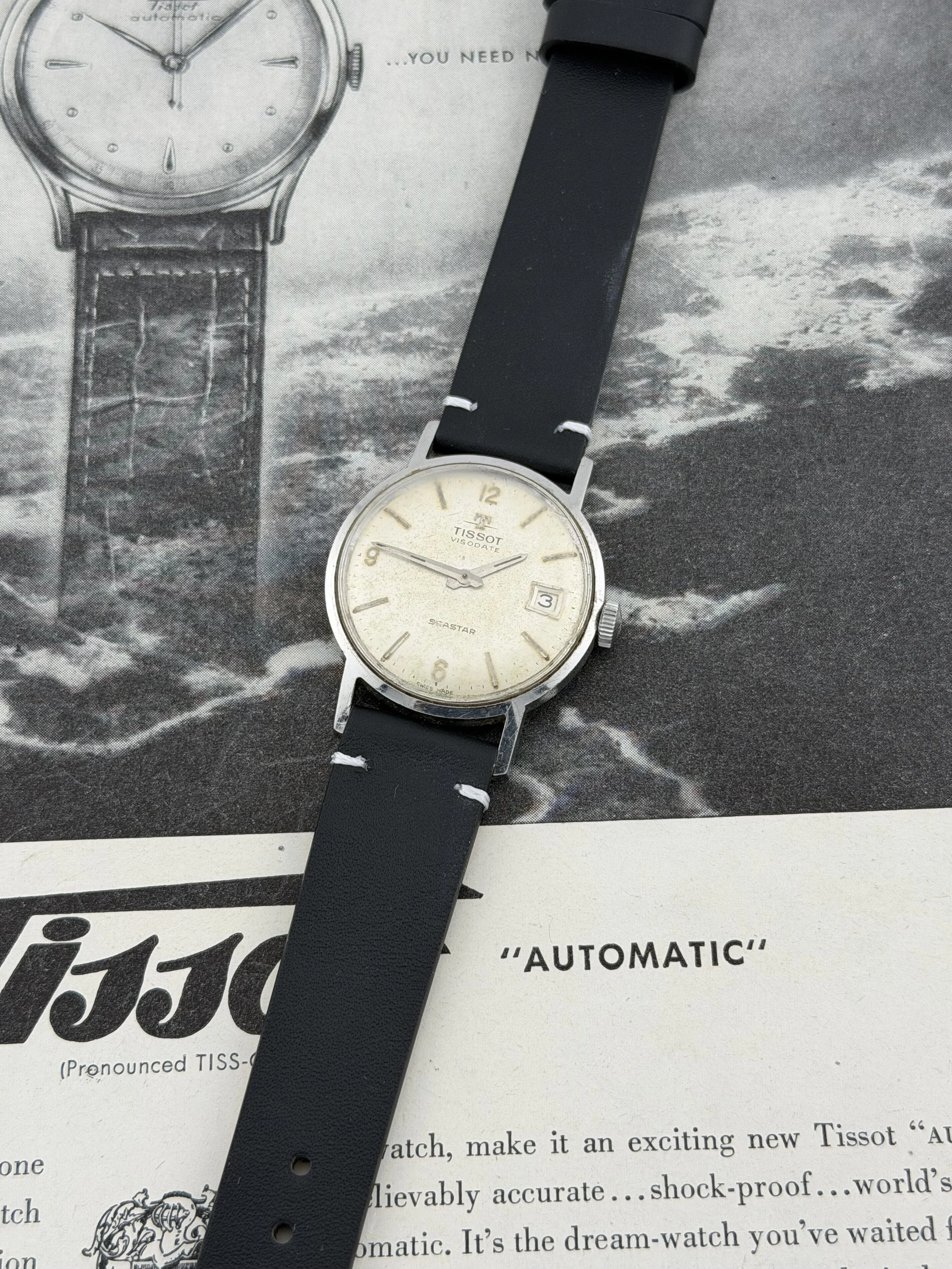
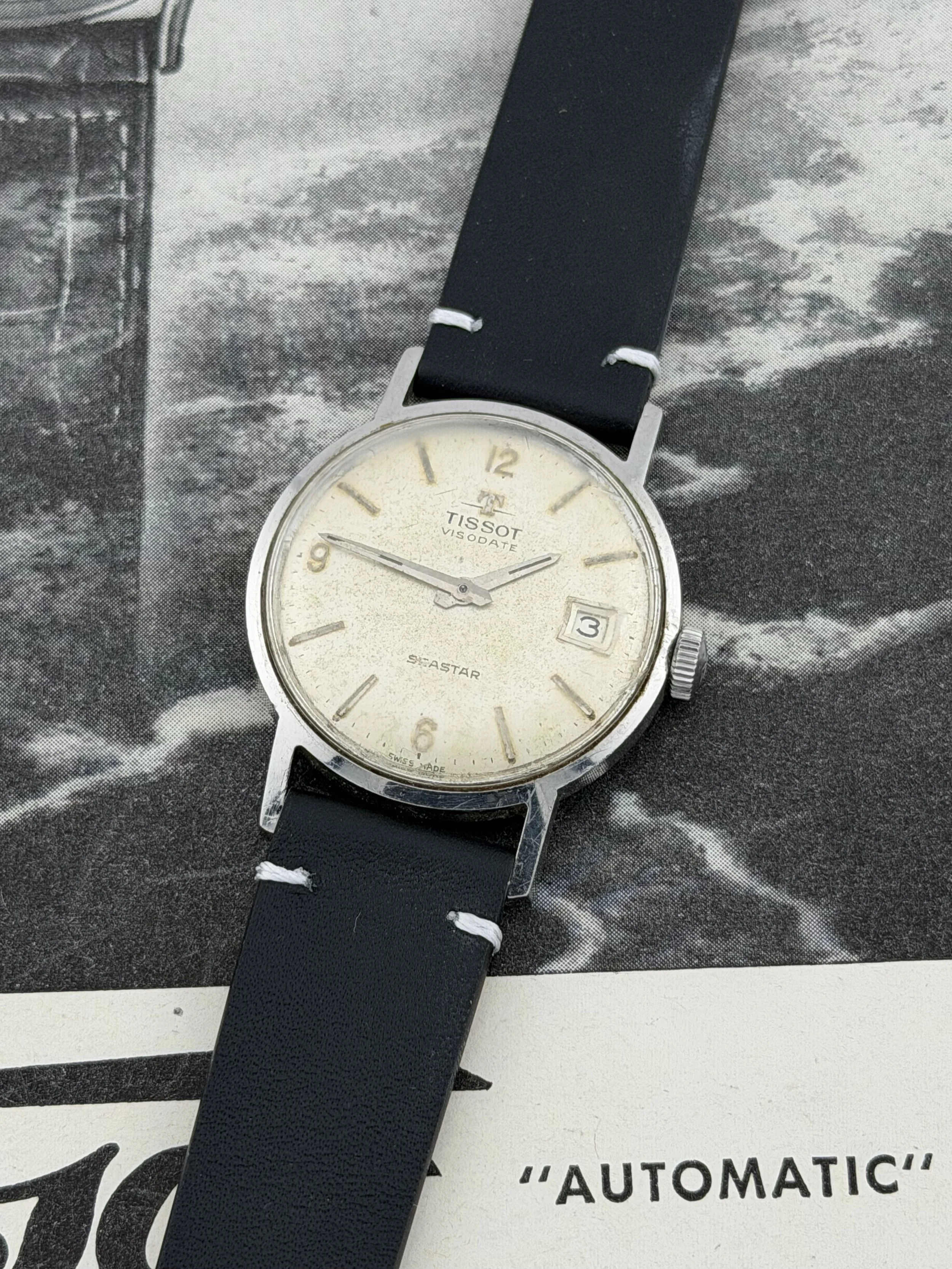
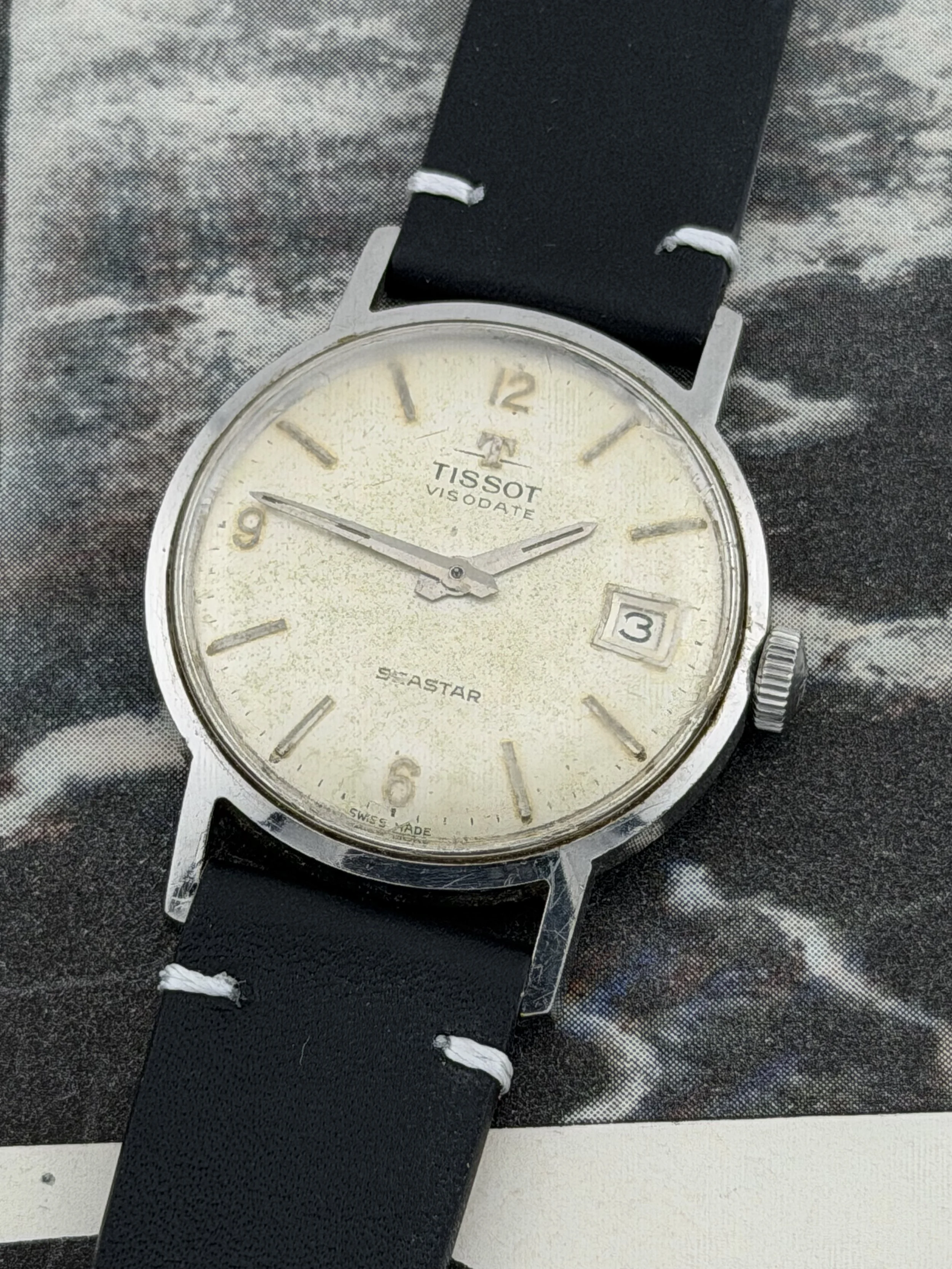
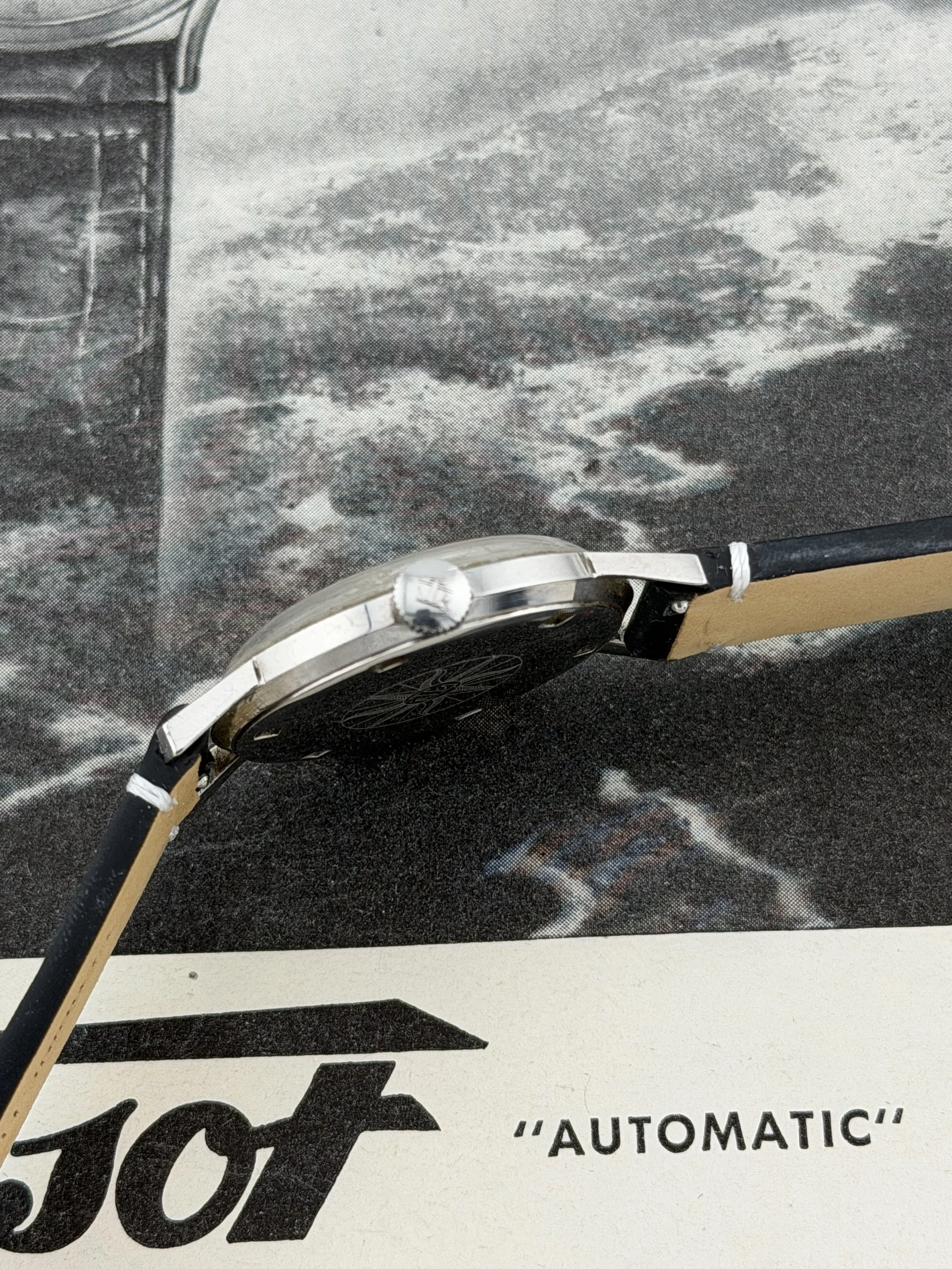
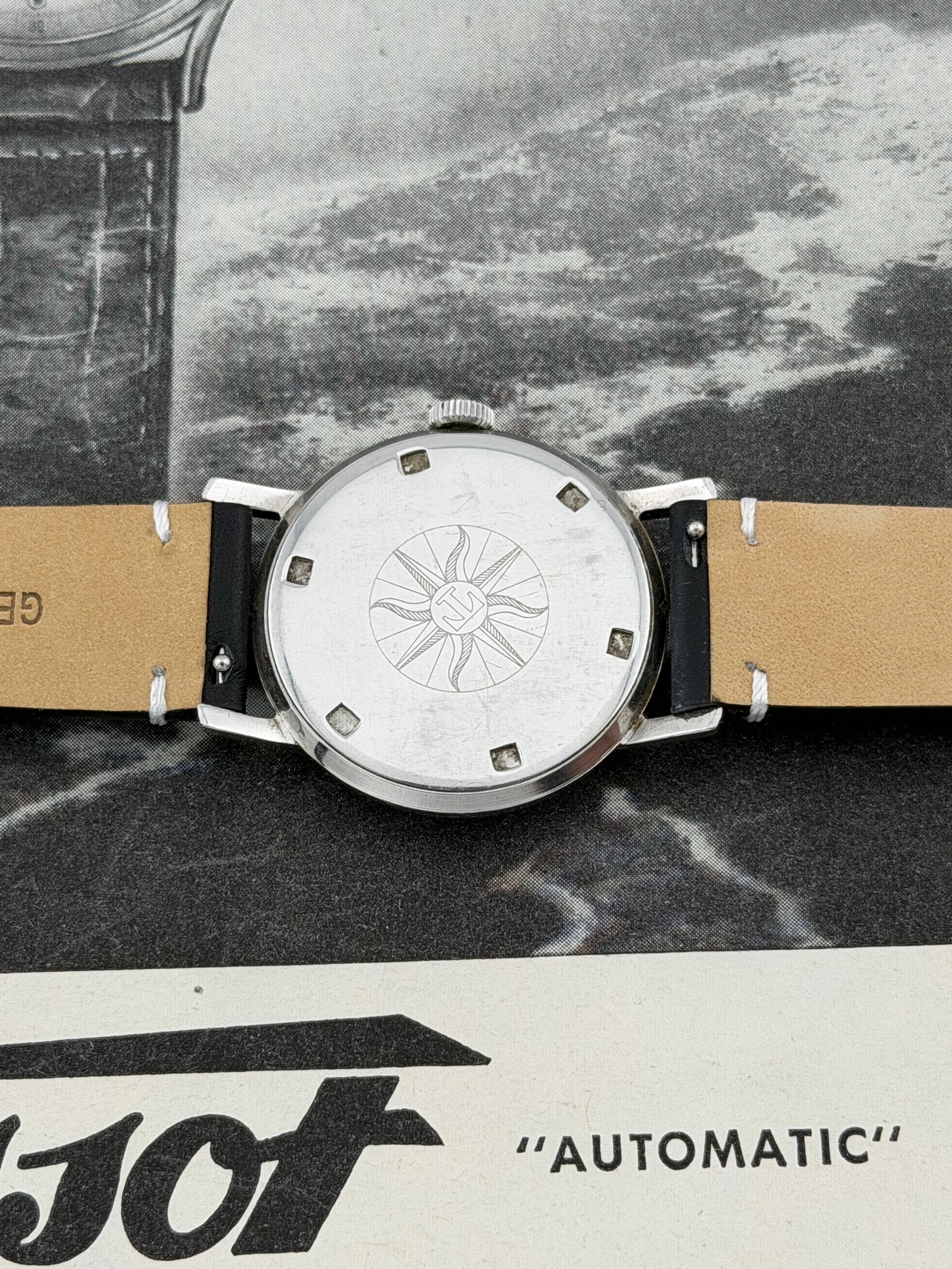
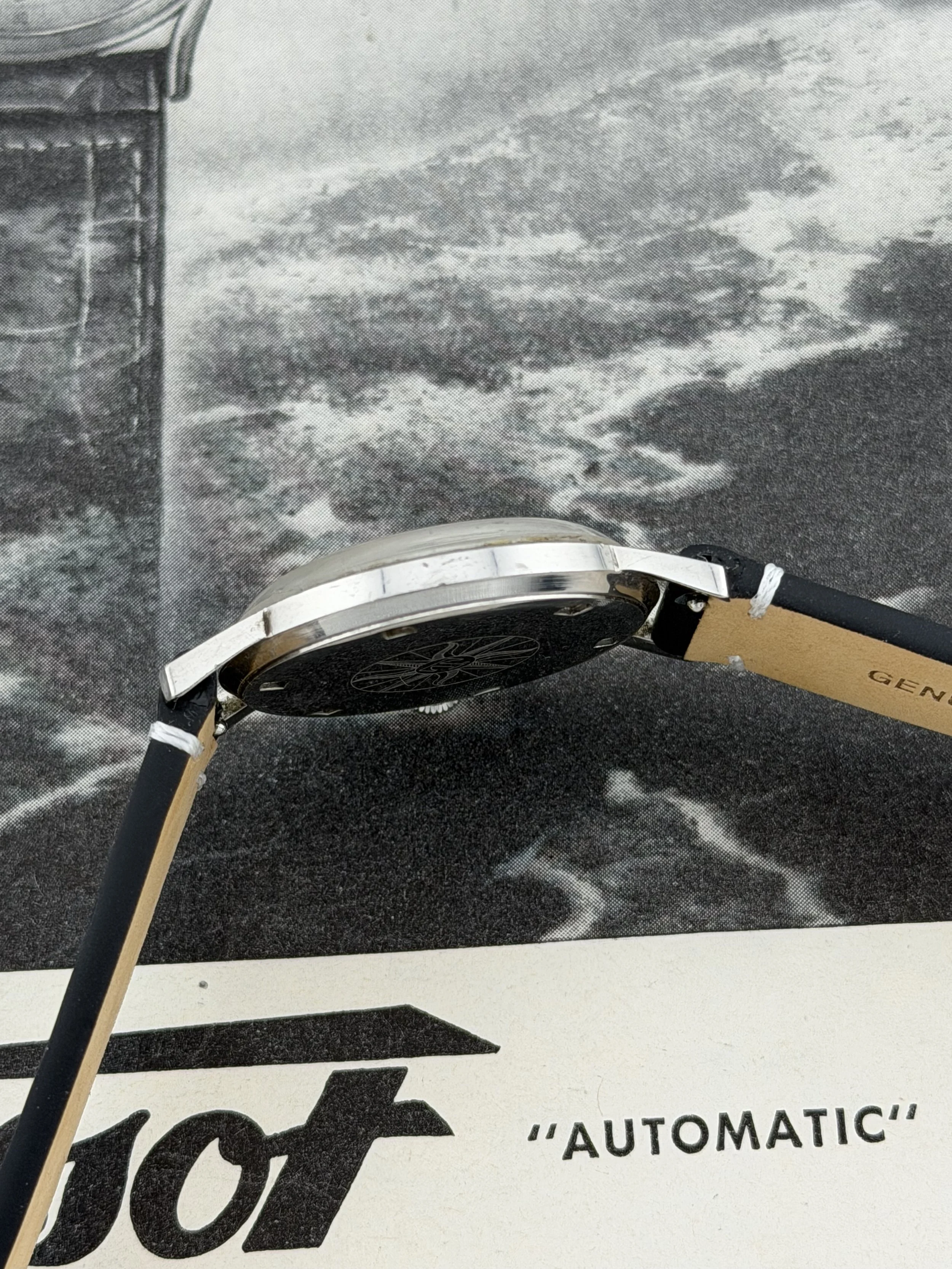
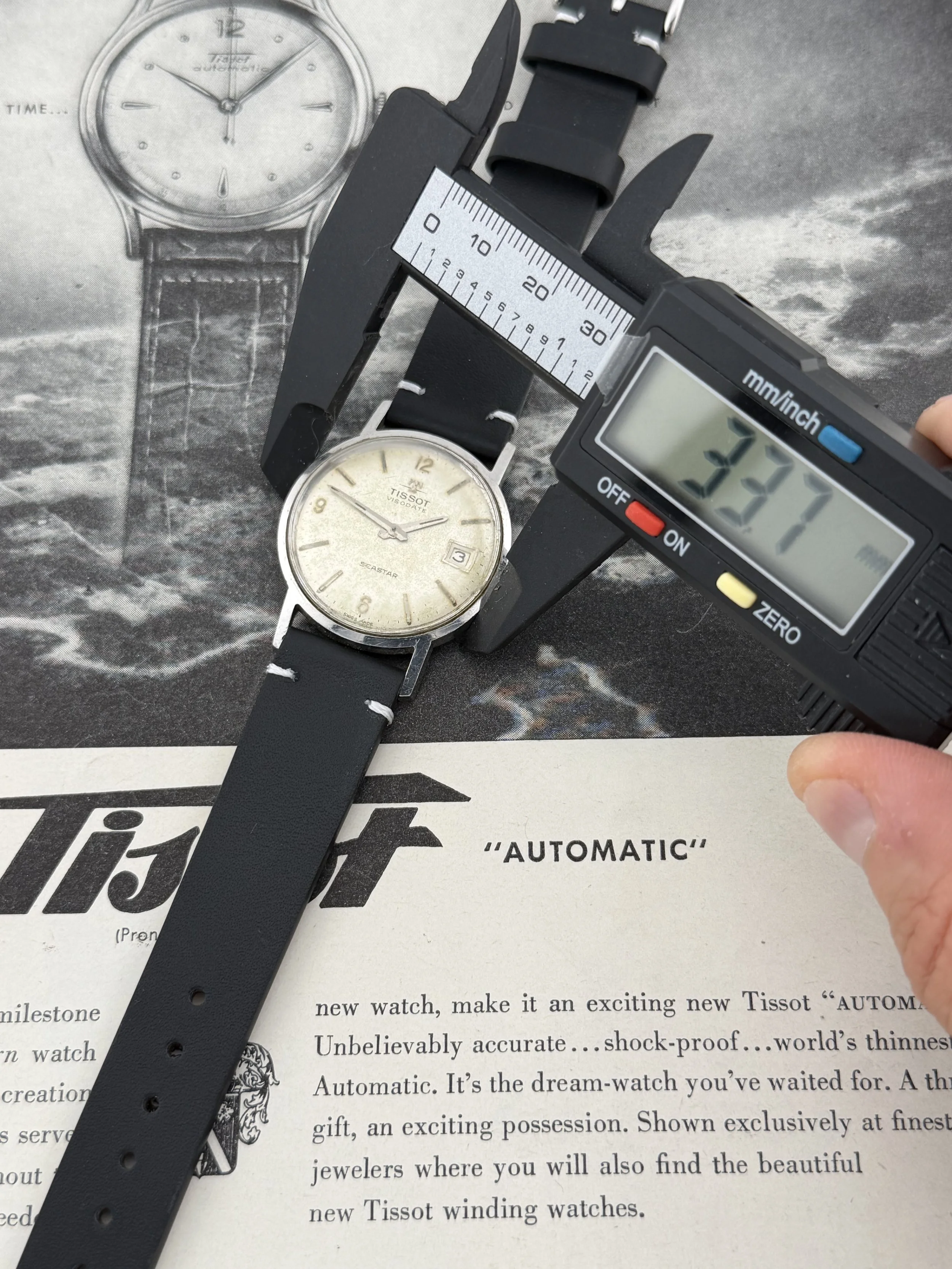
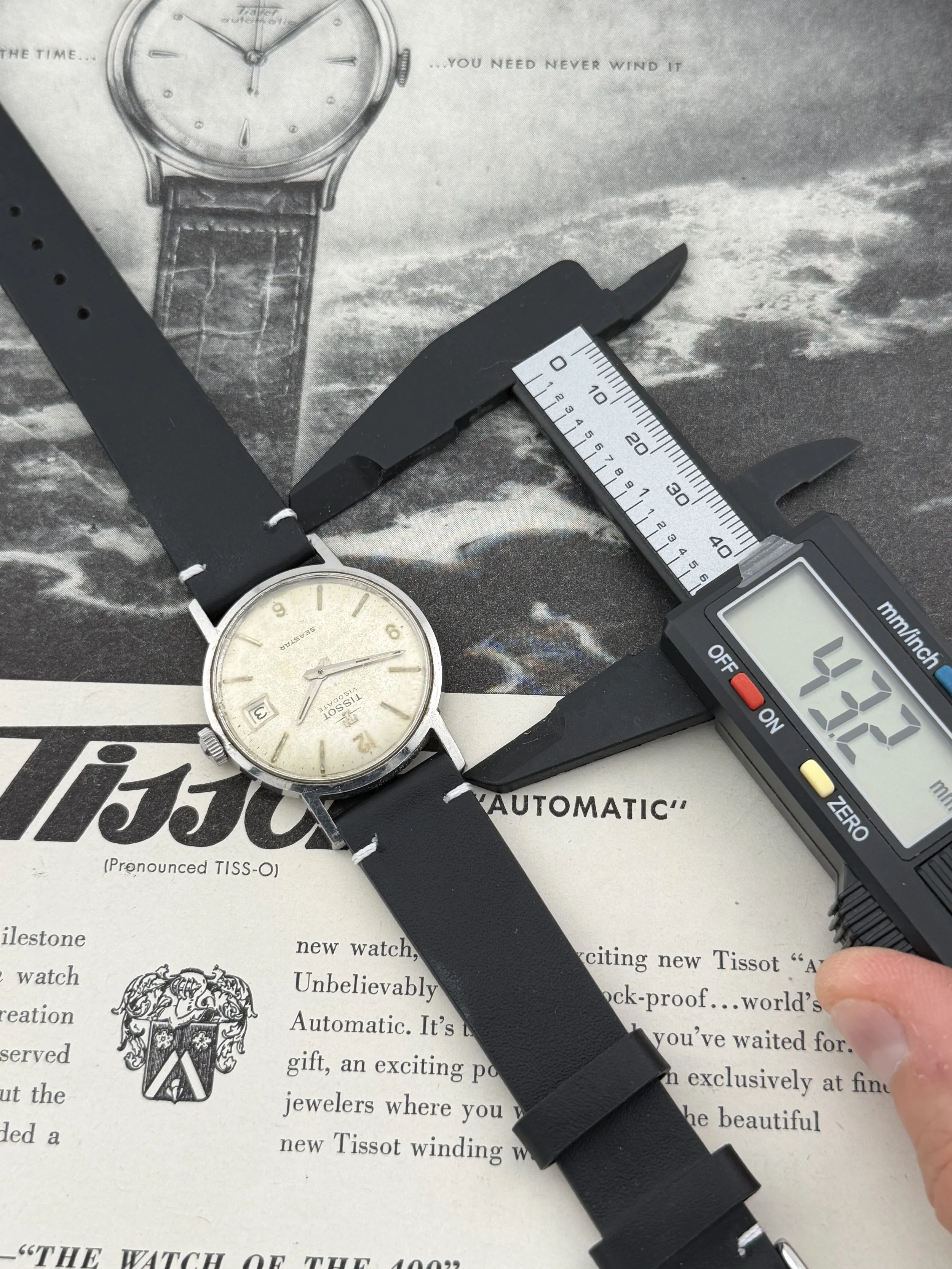
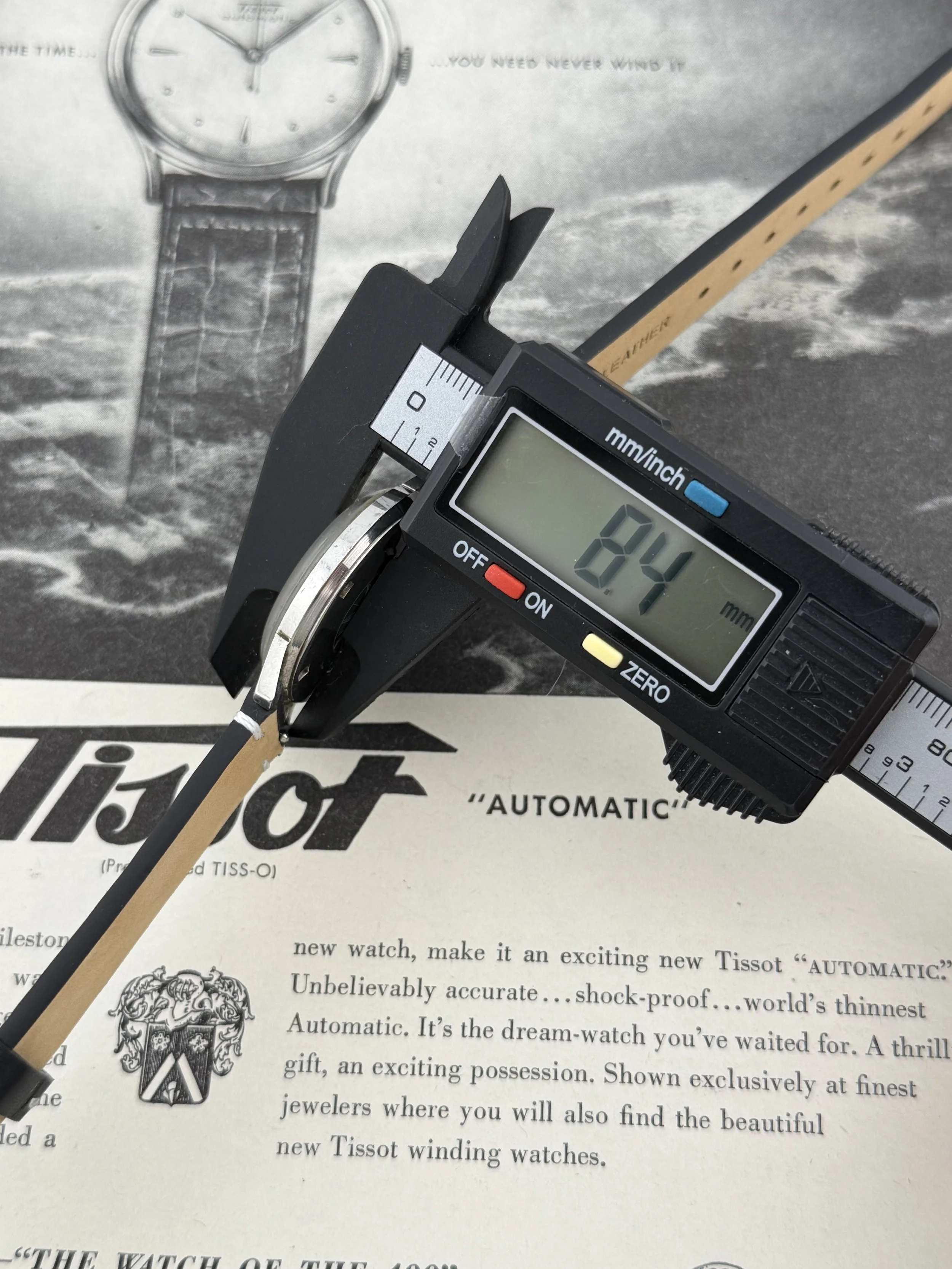
This beautiful 1962 Tissot Seastar Visodate is a wonderful example of mid-century Swiss watchmaking, combining one of Tissot's most recognizable model families with an exceptionally charming aged dial. With its historic patina, manually wound 17-jewel movement, and classic Seastar design, this is a watch that feels unmistakably authentic to its era.
The dial is the first thing that catches the eye. Years of natural aging have given it a wonderfully warm patina, creating subtle variation across the surface that makes the watch feel genuinely lived-in and individual. This is the kind of aging collectors often refer to as historic patina—the result of decades of exposure and time rather than something artificially created today.
There is something particularly appealing about a naturally aged vintage dial. Every mark, tonal shift, and change in colour tells a small part of the watch's story. Rather than trying to hide its age, this Seastar embraces it, giving the watch a personality that simply cannot be reproduced on a modern dial.
The Seastar name is also historically significant. Introduced as Tissot's water-resistant watch line, the Seastar became one of the company's enduring model families during the middle of the twentieth century. It represented Tissot's move toward watches that could combine elegant Swiss styling with greater resistance to the demands of everyday life.
The Visodate designation adds another important chapter to the watch's history. Tissot introduced the Visodate concept in the 1950s, combining automatic or mechanical watchmaking with calendar functionality. The name itself reflects the idea of displaying the date alongside the time, an increasingly useful feature during the post-war period when watches were becoming sophisticated everyday tools.
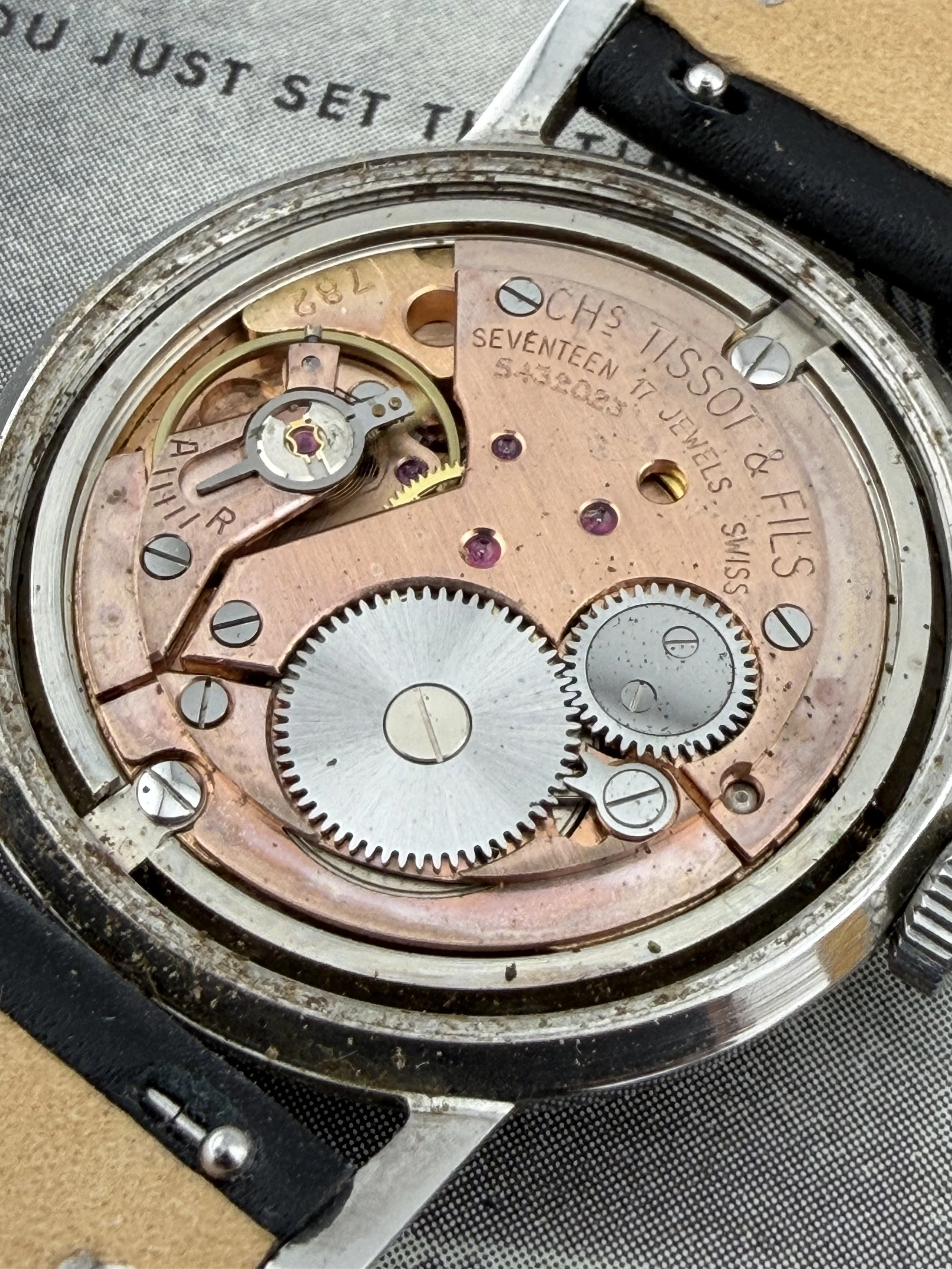
Inside is the Tissot calibre 782, a Swiss 17-jewel manually wound mechanical movement. The movement represents the traditional mechanical approach to watchmaking that remained at the heart of Tissot during this period. Each day, the wearer would wind the mainspring by hand, storing the energy that would gradually be released through the movement to power the watch.
There is something wonderfully tactile about a manual-winding watch. Instead of simply putting it on and forgetting about it, the owner becomes part of the mechanism's daily routine. A few turns of the crown bring the watch to life, creating a direct connection between the wearer and the mechanical movement.
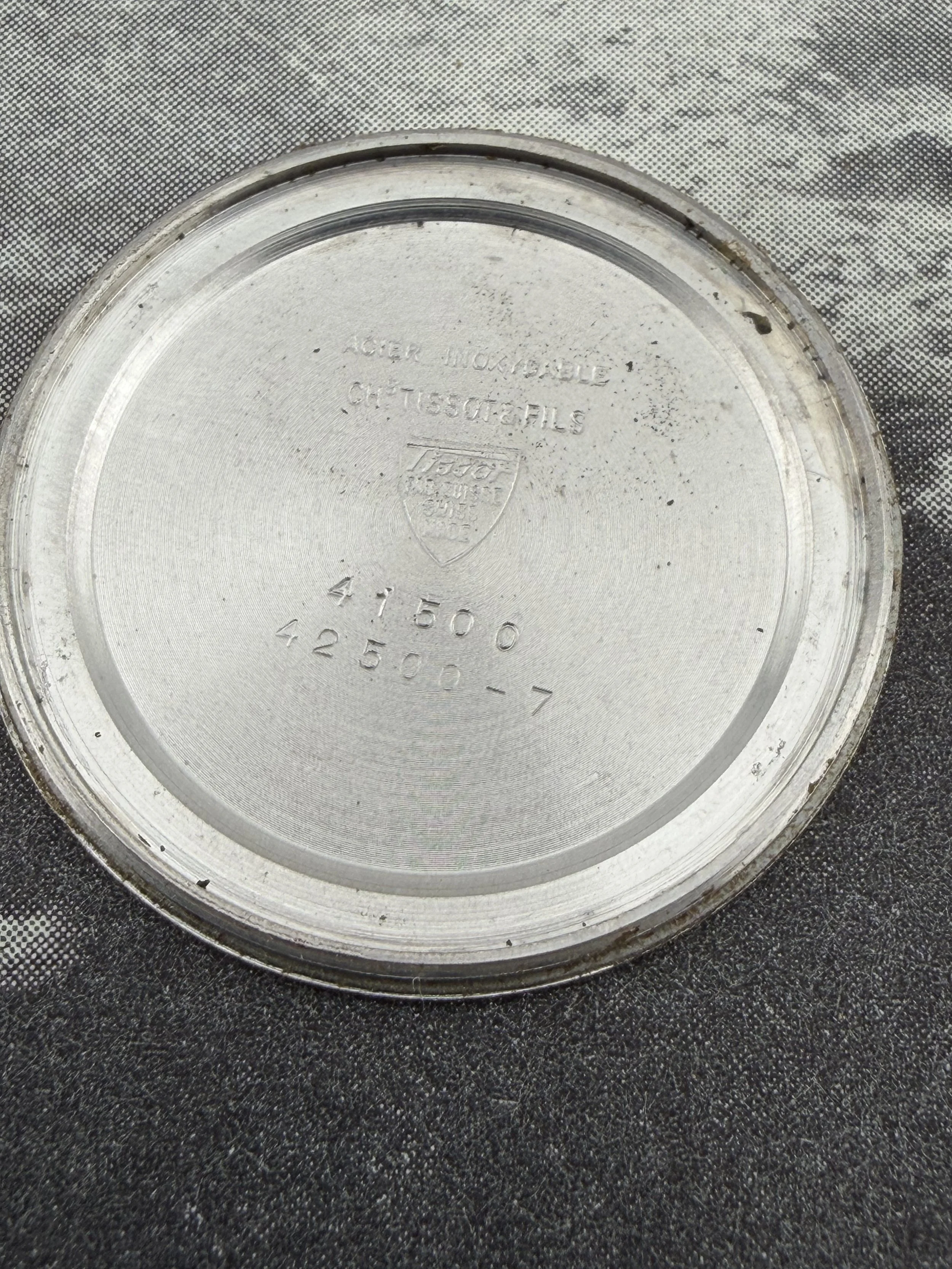
The movement is signed Tissot & Fils, Swiss, a marking that connects the watch to the company's long Swiss heritage. Tissot was founded in 1853 by Charles-Félicien Tissot and his son Charles-Émile in Le Locle, Switzerland, and grew from a small family operation into one of Switzerland's important watch manufacturers.
By the middle of the twentieth century, Tissot had established an international reputation for producing technically innovative watches while maintaining a more accessible position than some of Switzerland's most prestigious luxury houses. The company experimented with new materials, movements, and designs while remaining firmly rooted in traditional Swiss mechanical watchmaking.
The early 1960s were an especially fascinating period for the company. Swiss mechanical watches were becoming increasingly sophisticated, while designs were evolving toward cleaner, more modern proportions. The Seastar line embodied this transition beautifully, offering a watch that could be worn every day while retaining the refinement expected from a Swiss-made timepiece.
This 1962 example captures that moment perfectly. It is old enough to have accumulated more than six decades of history, yet its overall design remains remarkably wearable today. The combination of classic Tissot styling, the Seastar name, and the naturally aged dial gives it a character that modern watches struggle to replicate.
What makes this particular watch so appealing is that it doesn't try to look new. The patina is part of its identity. The dial tells you immediately that this is a watch that has traveled through time, while the original mechanical architecture underneath provides a tangible connection to the watchmaking of 1962.
For collectors who appreciate authentic vintage character, Tissot history, and traditional Swiss mechanical movements, this Seastar Visodate is a wonderful piece. With its 1962 production date, historic patina, Tissot calibre 782, 17-jewel manual-winding movement, and Tissot & Fils Swiss heritage, it represents a beautifully preserved piece of the golden age of Swiss watchmaking.
A genuine vintage Tissot with the kind of character that only six decades of history can create.
This beautiful 1962 Tissot Seastar Visodate is a wonderful example of mid-century Swiss watchmaking, combining one of Tissot's most recognizable model families with an exceptionally charming aged dial. With its historic patina, manually wound 17-jewel movement, and classic Seastar design, this is a watch that feels unmistakably authentic to its era.
The dial is the first thing that catches the eye. Years of natural aging have given it a wonderfully warm patina, creating subtle variation across the surface that makes the watch feel genuinely lived-in and individual. This is the kind of aging collectors often refer to as historic patina—the result of decades of exposure and time rather than something artificially created today.
There is something particularly appealing about a naturally aged vintage dial. Every mark, tonal shift, and change in colour tells a small part of the watch's story. Rather than trying to hide its age, this Seastar embraces it, giving the watch a personality that simply cannot be reproduced on a modern dial.
The Seastar name is also historically significant. Introduced as Tissot's water-resistant watch line, the Seastar became one of the company's enduring model families during the middle of the twentieth century. It represented Tissot's move toward watches that could combine elegant Swiss styling with greater resistance to the demands of everyday life.
The Visodate designation adds another important chapter to the watch's history. Tissot introduced the Visodate concept in the 1950s, combining automatic or mechanical watchmaking with calendar functionality. The name itself reflects the idea of displaying the date alongside the time, an increasingly useful feature during the post-war period when watches were becoming sophisticated everyday tools.
Inside is the Tissot calibre 782, a Swiss 17-jewel manually wound mechanical movement. The movement represents the traditional mechanical approach to watchmaking that remained at the heart of Tissot during this period. Each day, the wearer would wind the mainspring by hand, storing the energy that would gradually be released through the movement to power the watch.
There is something wonderfully tactile about a manual-winding watch. Instead of simply putting it on and forgetting about it, the owner becomes part of the mechanism's daily routine. A few turns of the crown bring the watch to life, creating a direct connection between the wearer and the mechanical movement.
The movement is signed Tissot & Fils, Swiss, a marking that connects the watch to the company's long Swiss heritage. Tissot was founded in 1853 by Charles-Félicien Tissot and his son Charles-Émile in Le Locle, Switzerland, and grew from a small family operation into one of Switzerland's important watch manufacturers.
By the middle of the twentieth century, Tissot had established an international reputation for producing technically innovative watches while maintaining a more accessible position than some of Switzerland's most prestigious luxury houses. The company experimented with new materials, movements, and designs while remaining firmly rooted in traditional Swiss mechanical watchmaking.
The early 1960s were an especially fascinating period for the company. Swiss mechanical watches were becoming increasingly sophisticated, while designs were evolving toward cleaner, more modern proportions. The Seastar line embodied this transition beautifully, offering a watch that could be worn every day while retaining the refinement expected from a Swiss-made timepiece.
This 1962 example captures that moment perfectly. It is old enough to have accumulated more than six decades of history, yet its overall design remains remarkably wearable today. The combination of classic Tissot styling, the Seastar name, and the naturally aged dial gives it a character that modern watches struggle to replicate.
What makes this particular watch so appealing is that it doesn't try to look new. The patina is part of its identity. The dial tells you immediately that this is a watch that has traveled through time, while the original mechanical architecture underneath provides a tangible connection to the watchmaking of 1962.
For collectors who appreciate authentic vintage character, Tissot history, and traditional Swiss mechanical movements, this Seastar Visodate is a wonderful piece. With its 1962 production date, historic patina, Tissot calibre 782, 17-jewel manual-winding movement, and Tissot & Fils Swiss heritage, it represents a beautifully preserved piece of the golden age of Swiss watchmaking.
A genuine vintage Tissot with the kind of character that only six decades of history can create.